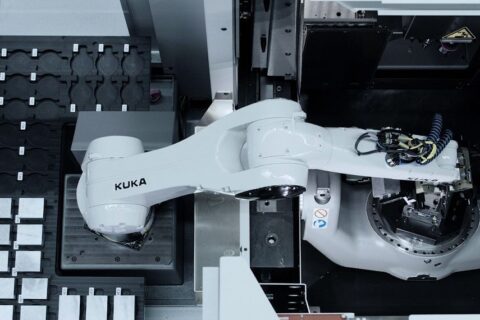

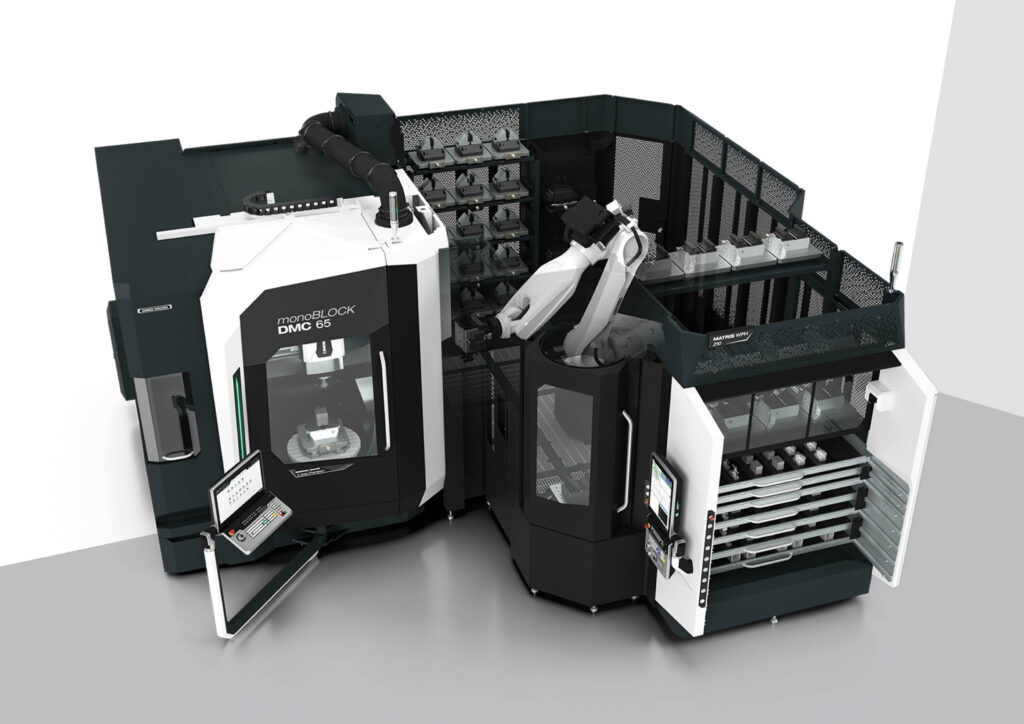
DMG MORI has introduced the MATRIS WPH as an automation option for manufacturers that need to handle both workpieces and pallets in changing order situations. The system is aimed at small and medium sized CNC users facing more component variants, tighter delivery times and limited skilled labor. Therefore, reducing manual handling can support higher machine utilization and more stable processes.
Small and medium sized manufacturers often have to balance flexibility with productivity. Components are becoming more complex, while batch sizes and product variants can change from order to order. In this environment, machine uptime is not only determined by cutting performance, but also by how reliably material is supplied, staged and transferred into the machining process.
DMG MORI places the MATRIS WPH within its Machining Transformation approach, which combines process integration and automation. The underlying issue is familiar in many workshops. Every time a component has to be reclamped or manually moved between staging and the machine, time is lost and the risk of quality issues increases. Skilled workers also spend time on repetitive tasks instead of activities that add more value. By automating workpiece and pallet handling around the work area, the MATRIS WPH is intended to reduce these interruptions without requiring a fully interconnected production system from the outset.
Reducing manual steps around the machine
The practical relevance of the MATRIS WPH lies in the connection between material supply and machine utilization. In many CNC environments, the machine itself is capable of productive operation, but the overall process is interrupted by manual loading, unloading or pallet exchange. These interventions may be necessary; however, they create waiting times and make production more dependent on operator availability.
By handling both workpieces and pallets, the system addresses two common automation routes in one setup. Workpieces can be fed and stored for direct integration into machining, while pallets can be used where the production strategy or machine setup requires them. This matters for companies that do not run one stable product in high volume, but instead deal with varying components and batch sizes.
Therefore the system is positioned less as a maximum interconnection concept and more as a flexible entry into automation. For users, the benefit is in coordinating machine uptime with material availability. Repetitive manual interventions are reduced, and the process around the machine becomes more predictable. As a result, manufacturers can make better use of skilled personnel while limiting avoidable handling steps between staging and machining.
One system for workpieces and pallets
Whether automation should focus on workpieces or pallets is often determined by the order mix. If order volumes vary significantly, a fixed approach can become restrictive. The MATRIS WPH is designed to integrate both handling methods, allowing workpieces and pallets to be fed, stored and brought into the machining process through a single automation system.
This flexibility is relevant for production environments with a broad range of variants. A shop may need pallet handling for one order and workpiece handling for another, depending on component geometry, setup strategy or batch size. Combining both options reduces the need to choose one direction too early in the automation path.
DMG MORI specifies the MATRIS WPH for use with several machine types. It can be installed on machines designed for 5 axis machining, including the DMU 50 3. Generation, the DMU 60 eVo 2. Generation and the DMC 65 and 75 monoBLOCK 2. Generation. It is also compatible with vertical machines from the NVX and CMX V series. This machine range indicates that the system is not limited to one narrow application, but is intended for different machining environments where flexible material handling is needed.
Different models for different handling requirements
The current MATRIS WPH range consists of the MATRIS WPH 70 and the MATRIS WPH 210. The two models differ in transfer weight, workpiece size and pallet configuration, allowing users to match the automation system to their machine and component spectrum.
The MATRIS WPH 70 is the smaller version. It supports a transfer weight of up to 35 kg and a maximum pallet size of 400 x 400 mm. This makes it suitable where lighter parts and smaller pallets are sufficient for the production task. The MATRIS WPH 210 is designed for heavier handling requirements, with a transfer weight of up to 135 kg and pallets measuring 500 x 500 mm.
For small and medium sized businesses, the important point is scalability. Automation does not have to start with a fully automated production line. The path can begin with manual setup, then move toward automated workpiece and pallet handling and later toward more flexible material supply. The MATRIS WPH fits into that staged approach by supporting both handling strategies within one system, giving manufacturers room to adapt as their order structure changes.