
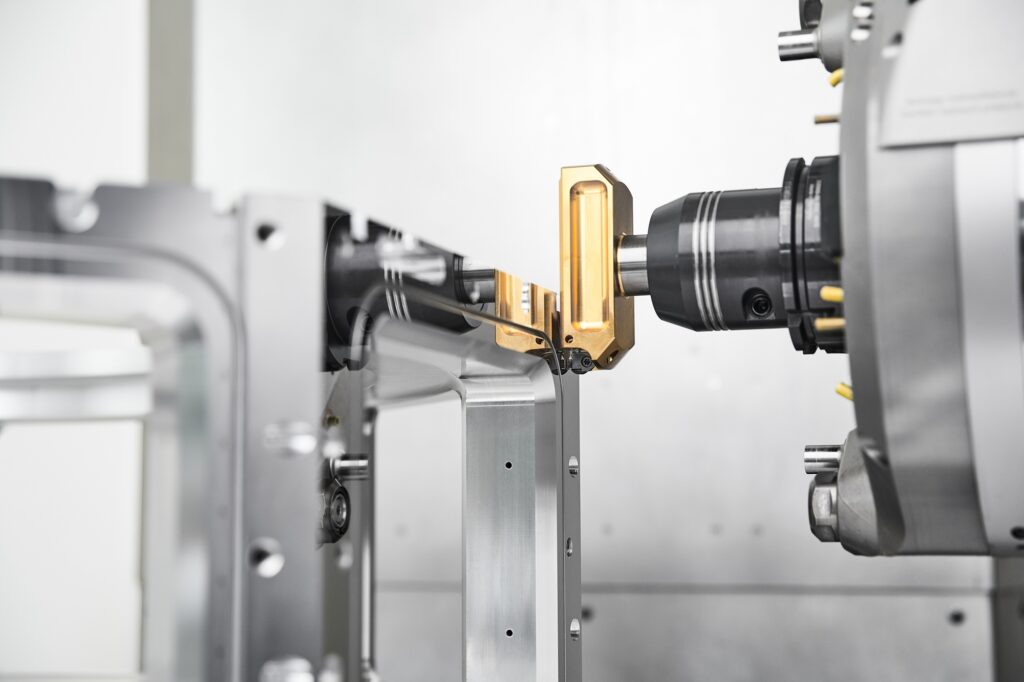
Contract manufacturers looking at the semiconductor market face a manufacturing challenge as much as a technical one. Components such as process chamber housings require micrometer range accuracy, stable surface quality and strict particle cleanliness. DMG MORI presents integrated manufacturing, automation and digital process control as a way to make these requirements reproducible under industrial production conditions.
The semiconductor sector is described by DMG MORI as one of the most dynamic growth markets in CNC manufacturing. For subcontractors, that creates opportunity, but it also raises the threshold for entering the market. Long machining times, tight tolerances and cleanroom-related requirements leave limited room for manual interfaces or unstable process chains.
The company positions its Machining Transformation approach around four pillars: process integration, automation, Digital Transformation and Green Transformation. In this context, the central issue is not a single machine feature, but the way manufacturing is organized, from machining and measuring to automation and data handling. Therefore, the aim is to reduce variation between process steps, make capacity more predictable and support repeatable production of complex semiconductor components in rising volumes.
Integrated processes reduce interfaces
Process integration is the technical foundation of the approach. DMG MORI points to the combination of milling, turning, grinding and measuring in one machine as a way to reduce setups and limit sources of error. For parts with micrometer-range tolerances, each transfer between machines and each manual intervention can introduce variation. Bringing more operations into one controlled system therefore supports reproducibility and process stability.
The practical relevance is strongest where parts have long cycle times and demanding quality requirements. If machining, finishing and inspection are linked more closely, manufacturers can shorten lead times and detect deviations earlier in the process. Fewer setups also reduce the risk of alignment errors and can help lower scrap. For contract manufacturers, this matters because semiconductor work is not only about achieving the required accuracy once. The requirement is to maintain it repeatedly, at scale and under production pressure.
Automation supports longer unattended periods
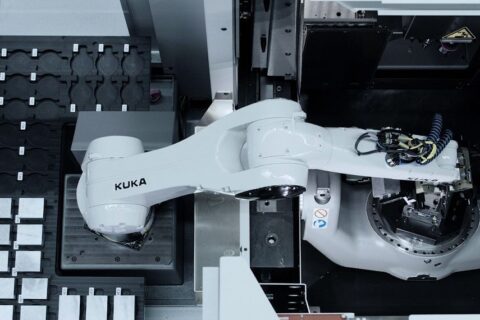
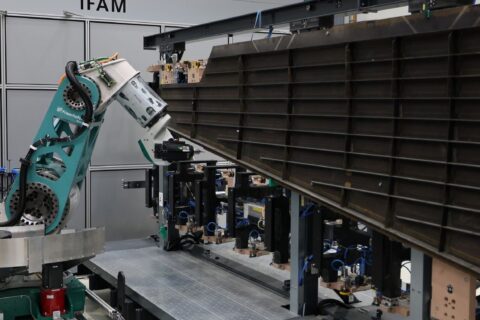
Automation becomes especially important when machining times are long. In such conditions, machine uptime has a direct effect on output, while additional staffing is not always a realistic or economical answer. DMG MORI highlights automated pallet handling systems and automated guided vehicles as building blocks for automated shifts and flexible production of different variants.
The benefit is not limited to labor reduction. Automated handling can improve planning reliability because machines can continue working through extended periods with less manual intervention. It also helps manufacturers use available spindle time more consistently. For contract manufacturers entering semiconductor supply chains, this can support higher capacity utilization and make production less dependent on individual manual operations.
Variant flexibility is another relevant point. Semiconductor components can be complex, and production requirements may shift between different workpieces or batches. Automated systems make it easier to organize such changes within a structured production environment, provided the process chain is set up coherently. In DMG MORI’s view, this is a key part of making semiconductor manufacturing scalable rather than treating it as isolated high-end machining.
Digital data chains add process control
As production becomes more integrated and automated, digital control becomes more important. DMG MORI links Digital Transformation to end-to-end data chains, simulations and digital twins. These tools are intended to support proactive planning and continuous optimization of manufacturing processes.
In practice, the main value lies in visibility. Real-time production data can show capacity utilization, lead times and quality status. That gives production teams a clearer basis for decisions than isolated machine data or delayed reporting. In a market where process reliability is critical, this transparency can help identify bottlenecks, monitor deviations and improve control over the full manufacturing flow.
Digital twins and simulation also have a role before and during production. They allow processes to be planned and assessed virtually, reducing uncertainty when complex components or new variants enter the workflow. DMG MORI frames this as part of an integrated system rather than a separate software layer. The closer the connection between machine, automation and digital process chain, the easier it becomes to manage quality and throughput together.
Cleanroom requirements affect the whole process
For semiconductor components, accuracy alone is not sufficient. Cleanroom quality is also part of the manufacturing strategy because even very small particles can affect sensitive components. DMG MORI states that cleanroom-related requirements are integrated into machine designs and process solutions, including equipment and coordinated media concepts.
Cooling lubricants are a specific example. They must support thermal and tribological stability during machining, but they also influence particle transport, residue behavior and later cleaning. This means the choice and management of media are directly connected to component cleanliness and process reliability, not just tool life or heat control. DMG MORI works with FUCHS SE of Mannheim as a DMQP partner for this aspect of the solution.
For contract manufacturers, this widens the definition of process capability. It is not enough to machine a part to specification if downstream cleaning or residue control becomes difficult. Cleanroom quality has to be considered from the beginning, alongside machining strategy, automation and inspection. That is why DMG MORI presents the path into semiconductor manufacturing as a holistic production task, from the machine through automation to the digital process chain.