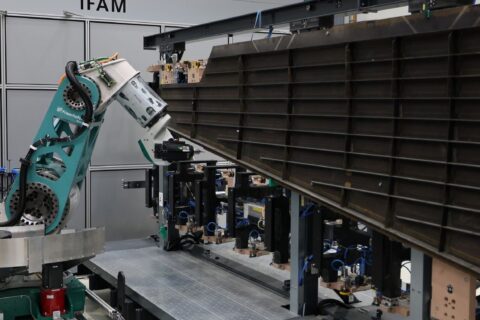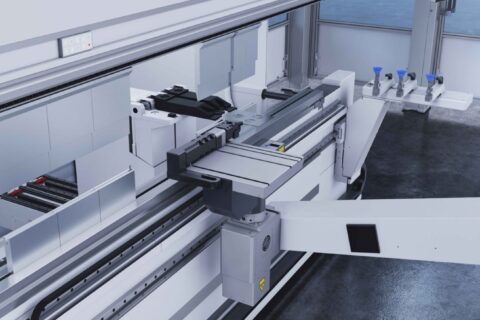

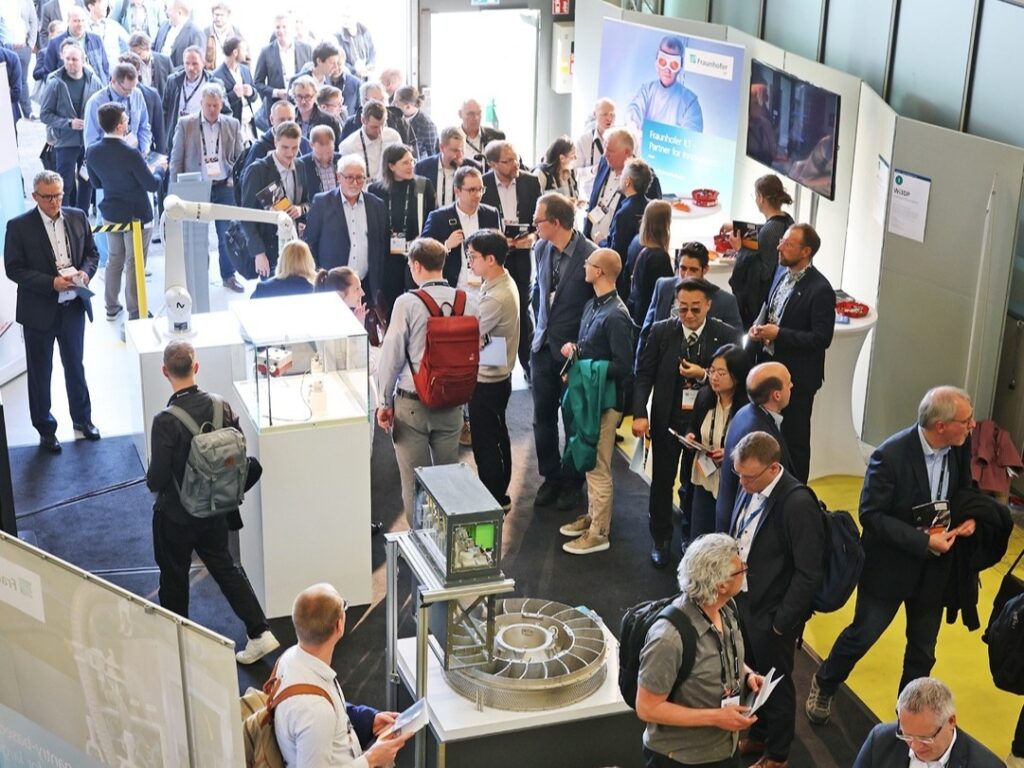
Industrial laser technology is moving toward higher power, deeper digital integration, and increasingly autonomous operation. At AKL 26 in Aachen, users, manufacturers, and researchers discussed how lasers and photonic systems are reshaping production in microelectronics, energy, aerospace, automotive manufacturing, and medical technology. The practical direction is clear. Lasers are becoming more intelligent, more scalable, and more closely linked to automated process control.
For three decades, the International Laser Technology Congress in Aachen has offered a platform for comparing the state of industrial laser technology with the requirements of production. This year’s discussions showed an industry that is still growing, but also changing in character. Market growth is moderate overall, while specific application fields are expanding quickly.
The global laser market is expected to rise from 14.5 billion USD in 2024 to more than 15.5 billion USD in 2025, according to Dr. Thierry Robin of TEMATYS. Dr. Stefan Ruppik of Coherent, representing the VDMA working group for laser and laser systems for material processing, reported similar movement, with the market for laser material processing systems growing by 4 percent. However, the picture is not uniform. Dr. Henrikki Pantsar noted a sharp fall in investment by automakers in the United States, while spending on new data centers is expected to support sales for laser manufacturers.
China strengthens its position in laser systems
The Chinese laser market remains one of the clearest indicators of where industrial laser technology is developing. Dr. Bo Gu of BOS Photonics reported solid growth, supported by a strong trade fair environment. LASER Shanghai reached new records in March, with 1,500 exhibitors and 58,000 visitors. For laser material processing systems in China, Gu expects growth of 6 to 7 percent in both 2025 and 2026.
The figures for individual laser segments show even stronger movement. The fiber laser market has grown by 9.8 percent, while ultrashort pulse lasers have grown by 14.7 percent. For manufacturers outside China, the more striking figures concern domestic market share. Chinese manufacturers account for 98 percent of lasers in the 3 to 6 kW power range in their home market. For lasers above 10 kW, their share is around 80 percent. That means the Chinese market for industrial lasers is largely supplied by local companies.
For production companies, these figures matter because they show both the maturity of laser applications and the importance of regional supply structures. As higher power levels and ultrashort pulse systems become more widely used, competition is increasingly linked not only to the laser source itself, but also to integration, process knowledge, and the ability to connect systems into automated production environments.
Photonics becomes part of the production backbone
While laser-based machine tools are generally estimated to represent a market of 10 to 20 billion euros, laser-enabled products are measured in the trillions. Smartphones, computer chips, and many cars are now produced with the help of laser technology. Photonics has therefore become a cross-sectional technology, combining lasers, optical components, and complex processes to support progress across several industries.
This broader role was reflected in the Gerd Herziger session on new perspectives for lasers in science and industry. Trevor Ness of IPG Photonics described the future direction in clear terms, saying lasers will become integrated, scalable, and intelligent. In practice, this points to laser-equipped robots that can raise productivity and operate in environments unsuitable for people. The enabling technologies are already becoming more digital and more powerful.
Power scaling is one of the visible signs of this change. Dr. Jochen Stollenwerk, acting director of Fraunhofer ILT, stated that the average power of ultrashort pulse lasers is reaching the double-digit kilowatt range through developments at the Fraunhofer Cluster of Excellence Advanced Photon Sources, CAPS. Continuous wave lasers have already exceeded 100 kW, according to company representatives. Higher power alone is not the full story, but it widens the process window for cutting, welding, structuring, and deposition tasks that demand speed, stability, and reliable energy input.
Energy applications push high power lasers into heavy industry
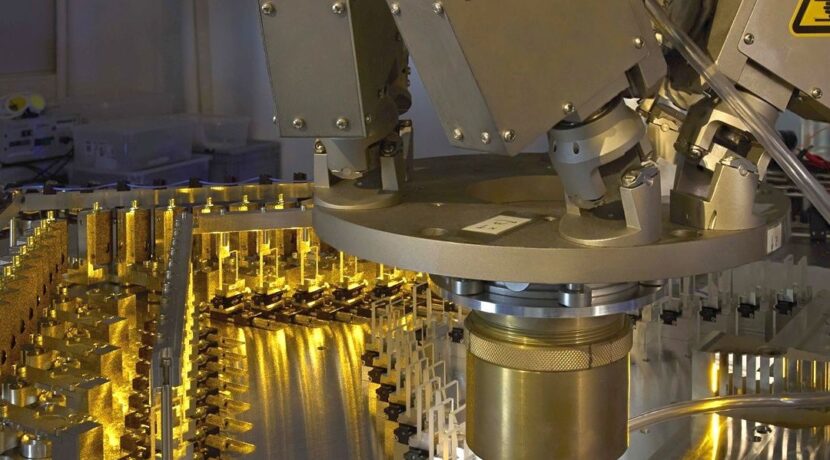
The energy sector is already using high power lasers in demanding industrial settings. Dr. Alexander Olowinsky, head of the Joining and Cutting Department at Fraunhofer ILT, described it as one of the first areas of application for laser systems above 50 kW. At these power levels, lasers can cut doors in wind turbines and thick steel walls during the decommissioning of nuclear power plants. They can also weld new containers with walls several decimeters thick.
These applications show why power scaling is relevant beyond laboratory performance figures. Thick section cutting and welding place high demands on process stability, energy delivery, and system reliability. If laser systems can handle these tasks, they become practical tools for sectors where components are large, materials are difficult to process, and downtime is costly.
Fusion research could increase the scale of photonics even further. Prof. Constantin Häfner of Fraunhofer discussed Germany’s Fusion Action Plan, which includes more than two billion euros for fusion research and the goal of building the world’s first fusion power plant in Germany. He also pointed out that the cost of laser diodes for only a few fusion power plants would exceed the volume of the current laser market. That would make lower component costs essential, while also creating potential spin-off markets in industrial dry processes, space applications, and defense.
Automotive production moves toward autonomous decisions
Automotive manufacturing is already highly automated, and lasers fit naturally into this environment because they are digital tools. Dr. Andreas Russ of Bosch Manufacturing Solutions used next-generation battery production to show how far this integration has progressed. Compared with 2015, both battery sizes and machine sizes have multiplied. At the same time, production equipment is becoming more intelligent.
The production line described by Russ is networked, uses digital twins, and can make autonomous decisions based on simulations. For manufacturers, this is a significant step. Laser processes are no longer isolated stations that perform a fixed task. They are becoming part of a larger data-driven manufacturing system, where simulations, process feedback, and automation influence decisions during production.
Volkswagen’s use of high-speed laser material deposition offers another example. Markus Harke presented the production of brake discs using a process developed at Fraunhofer ILT. The brake discs produce 90 percent less fine dust and meet the Euro 7 standard. The process also supports largely automated production at high volumes. Dr. Thomas Schopphoven of Fraunhofer ILT noted that at such production volumes, the laser is no longer the cost driver. The main cost factor is the filler material.
Laser structuring reaches aircraft surfaces and microelectronics
In aviation, laser technology is being used to reduce fuel consumption through surface structuring. The shark skin technology from 4Jet GmbH, which received the Innovation Award Laser Technology 2026, enables large-scale micro machining with a CO2 laser. The process uses interference patterns to create more than 1,000 riblets in a single pass. These microstructures reduce aerodynamic drag and can deliver fuel savings of up to 3 percent for aircraft.
The company has more than 800 systems in operation, serving aviation, semiconductor, and solar applications. In aerospace maintenance and repair, laser material deposition has also become established. Companies such as Rolls Royce use these processes to repair engines and continue to refine them.
Microelectronics is another field where laser technology is embedded in high-volume manufacturing. Oliver Haupt of Coherent discussed applications in micro LEDs, while Dr. Christian Buchner of SCHMID Group focused on glass substrates for addressing bottlenecks in data transfer between processors and high-bandwidth memory. With selective laser-induced etching, holes can be drilled in transparent materials such as glass to create through-glass vias. The industrial process provides high surface quality and high aspect ratios. Dr. Dennis Haasler of Fraunhofer ILT also highlighted beam shaping, including Bessel beams and multi-beam systems, which enable parallel use of ultrashort laser pulses.
Medical applications link lasers to safer procedures
Optical technologies are now part of everyday clinical practice, from diagnosis to treatment. At AKL 26, Prof. Christian Blume of UK Aachen showed how imaging and laser-based developments are changing complex spinal surgery. In his examples, the success rate rose from 40 percent with freehand surgery to 99.5 percent after the introduction of intraoperative computed tomography.
The next step is being pursued in the SaveCut project, where Fraunhofer ILT is working with Blume on a robot-assisted laser osteotome for minimally invasive spinal surgery. The practical aim is greater safety during procedures where accuracy and controlled material removal are critical.
Implantology is moving in a similar digital direction. Frank Reinauer of KLS Martin explained how selective laser melting is used within digital workflows to produce patient-specific implants more effectively. The process allows 5 to 15 implants to be produced in one run. New resorbable materials, including magnesium alloys and polyethylene, support bone tissue growth while the implant gradually dissolves in the body.
AI brings closed loop laser production closer
Artificial intelligence was one of the clearest themes in the final part of the congress. Prof. Carlo Holly of RWTH Aachen University and Fraunhofer ILT described AI-driven innovation in photonics as a development that now reaches across the full process chain. It affects optical component design, quality assurance, simulation with digital twins, and closed-loop control for first-time-right production.
Among the recent developments from his research are self-supervised learning methods that can reduce AI training time from weeks to minutes. Another development is AI-generated optics, which can change beam profiles during the process without mechanical components. For industrial users, this points to laser systems that adapt more quickly to changing requirements and can process larger data volumes than conventional control approaches.
Holly’s central point was that AI is entering every level of laser technology, from planning to process control and autonomous operation. As data volumes rise, autonomous control becomes less of a distant concept and more of a practical requirement. Work on self-learning machines, autonomous laboratories, and autonomous factories is already underway in Aachen.