
Automation remains a priority in metal cutting, even as the robotics and automation industry expects lower turnover in 2026. According to Patrick Schwarzkopf of the VDMA Robotics + Automation Association, demographic pressure, easier programming, and advances in AI are pushing manufacturers toward collaborative processes. This also applies to small and medium-sized companies that previously saw robotics as too complex.
The investment climate is not simple. Schwarzkopf points to geopolitical turbulence and familiar regional factors as reasons for current hesitation. However, the need to automate has not weakened. Manufacturing companies still need to support skilled employees, keep processes competitive, and handle production tasks more flexibly.
This is changing the role of robotics in machining environments. Automation is no longer viewed only as a tool for large-scale production with stable volumes. It is increasingly relevant in small batch and mixed production, where fast setup and simple operation matter. AMB 2026 will place this development at the center of its automation focus, with particular attention to collaborative processes, machine tending, mobile robotics, and systems that make robot use more accessible on the shop floor.
Lower barriers for small and medium-sized companies
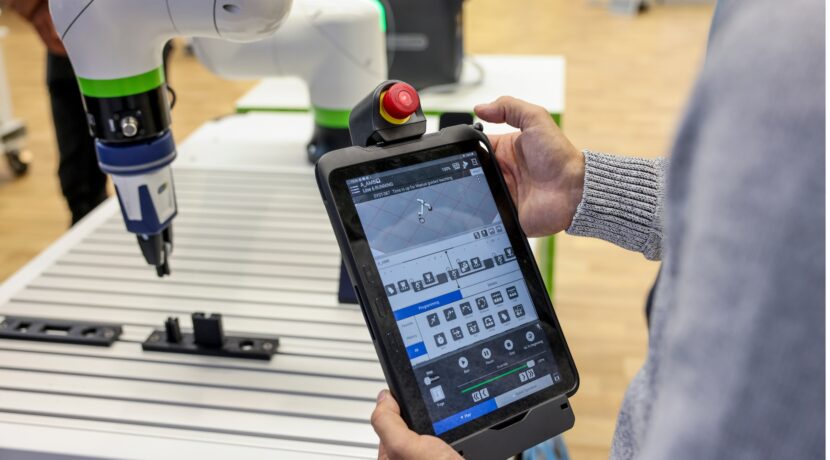
For many smaller manufacturers, the decisive change is not a single robot type, but the way automation can now be programmed and operated. Schwarzkopf describes low volume, high mix scenarios as typical for small and medium-sized enterprises. In these environments, employees need to create or adjust automation processes quickly, without extensive programming effort.
No-code approaches are becoming important here. Instead of writing code, users can build automation processes through graphical interfaces, often using drag and drop functions. Robot paths can also be taught by demonstration and stored at the touch of a button. As a result, the knowledge threshold is lower for companies that do not have dedicated robotics programmers.
Schwarzkopf argues that the technical solutions are already available, including from major manufacturers with systems tailored to SMEs. He also stresses that pragmatic setups can be enough. A robot that continues working overnight, for example, can create a meaningful productivity gain without requiring a highly complex automation concept. The remaining barrier is often the assumption that automation is always too complicated or too expensive. According to Schwarzkopf, this perception no longer matches the current state of the technology.
Collaboration is moving beyond fenced systems
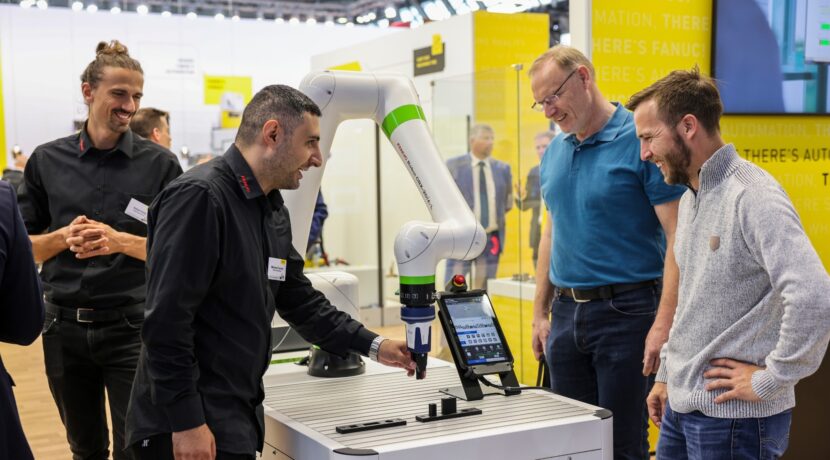
Collaborative robots are already established in industrial use, but the term collaboration covers different levels of interaction. In many current applications, robots and people mainly work in coexistence. They share a workspace without safety fences, but their tasks remain largely separate. This is already relevant for manufacturers that want more flexible production layouts and less rigid separation between manual and automated work.
A closer form of collaboration is emerging through developments in AI. Schwarzkopf refers in particular to the interpretation of the environment and the ability of systems to act appropriately and independently. This is especially visible in humanoid robotics, where robots are beginning to move from research laboratories into early industrial test applications.
Broad use is still some way off. Schwarzkopf is clear that further research is needed before humanoid robots become widely applicable in manufacturing. Even so, these systems point to a new direction for human-machine interaction. One practical example he mentions is the possibility of speaking to robots. For production companies, this suggests that the usability of automation will increasingly depend not only on mechanical performance, but also on how naturally employees can instruct, adapt, and work alongside robotic systems.
Machine tending remains a key robotics application
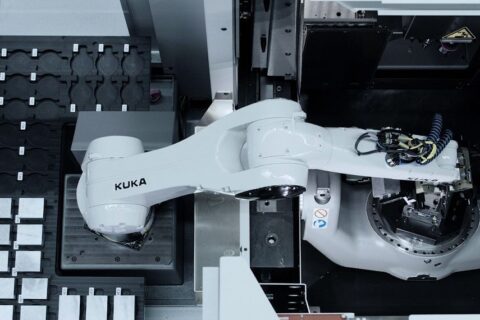
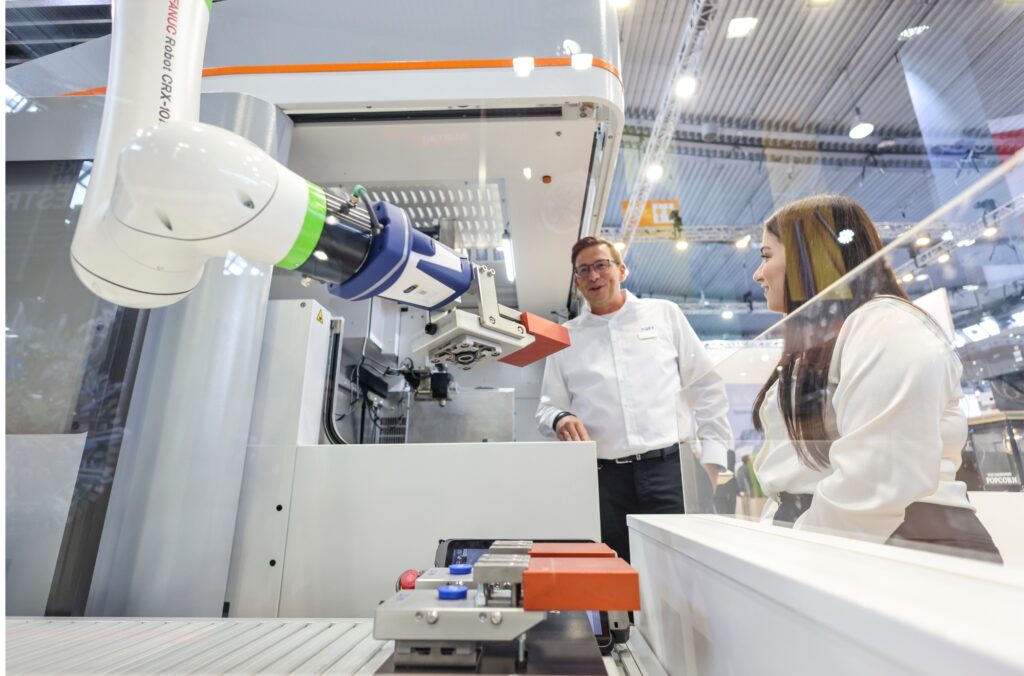
In metal cutting, one of the clearest automation use cases is machine tending, the automated loading and unloading of parts at processing machines. Schwarzkopf refers to figures from the International Federation of Robotics showing that this remains one of the main robotics applications.
The growth is measurable. The number of new robots installed annually for handling applications at machine tools increased from 14,500 units in 2015 to 19,000 units in 2024. Preliminary figures for 2025 indicate further growth in the double-digit percentage range. These numbers show that automation around machine tools is not a future concept, but an established and expanding part of production.
The practical relevance is straightforward. Automated tending can reduce the amount of manual loading work, support longer machine running times, and help companies make better use of available skilled labor. This is particularly important in an environment where demographic change is expected to make labor availability more difficult. For manufacturers, the question is increasingly how to integrate handling technology into existing machining processes in a way that fits their batch sizes, workpiece variety, and staffing situation.
Mobile robotics adds flexibility to production networks
Another area showing strong growth is mobile robotics. Schwarzkopf identifies this as the segment with the greatest increase, particularly where it enables flexible networking of machinery. One example is the mobile manipulator, a mobile platform combined with a robotic arm.
This development is relevant because many machining environments are not built around a single isolated machine. Parts, tools, and fixtures move between different stations, and production requirements can change. Mobile systems can support this type of environment by connecting machines more flexibly than fixed automation alone.
The rise of collaborative robots also reflects this broader shift. In 2024, around 65,000 collaborative robots were installed worldwide, representing 12 percent of all industrial robots. Their appeal lies not only in their ability to work near people, but also in their potential to fit into production areas where conventional automation would require more rigid layouts.
For companies considering automation, this widens the range of possible entry points. Automation can be linked to machine tending, handling, setup support, process management, or flexible internal movement, depending on the production challenge. The main task is to match the system to the actual process rather than starting from a fixed idea of what automation should look like.
AMB 2026 puts automation across the machining process
AMB 2026 will present automation across nearly all halls, including machine tools with automation systems and solutions for tool and clamping technology, such as automated machine setup. The main focus area for Automation and Handling Technology will be in the Oskar Lapp Hall, Hall 6.
Exhibitors including FANUC, KUKA, Cellro, RoboJob, and Wassermann Technologie are scheduled to show solutions for production and process management. The broader exhibitor field will cover robotics, collaborative automation, Industry 4.0 concepts, and IIoT in relation to machining processes.
For visitors involved in metal cutting, the value lies in seeing how these elements connect in practical production contexts. Programming concepts, cobots, machine tending, mobile platforms, and automated setup support can be evaluated more clearly when they are shown alongside the machines and processes they are intended to serve. AMB will take place from 15 to 19 September 2026 in Stuttgart.