
Metalworking companies face a practical digitalization challenge. They must connect machines and work processes while addressing key bottlenecks. The first NexGeM trade show will take place alongside Hannover Messe from 5 to 8 April 2027. It will bring together metalworking professionals and specialists in IT, automation and digitalization. Progress varies widely between factories, according to Prof. Jürgen Fleischer. He directs the wbk Institute of Production Science at the Karlsruhe Institute of Technology. The level of digitalization does not necessarily correspond to company size. However, suppliers to the automotive industry are generally well positioned because of customer pressure.
For companies exposed to global competition, preparing quotations and delivering quickly depend on more than one machine or software package. Fleischer argues that the entire process chain must become faster. Yet gaps remain. Data may still be collected at one station, exported to a spreadsheet, copied onto a USB drive and imported at the next. The transition also requires time and resources. Fleischer estimates that a mainly analog business could need up to five years to become fully digital. Alongside technology, companies need employees with digital skills. They also need training to support the change.
From pilot projects to connected processes
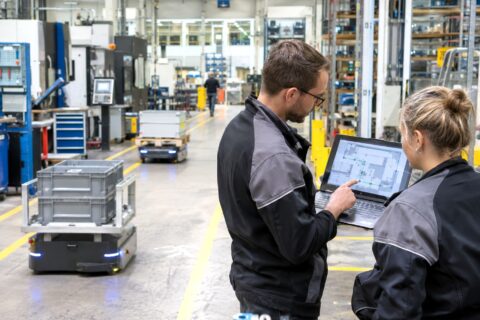
Fleischer cautions against treating digitalization as a pilot project alongside daily operations. In his view, management must examine the complete workflow. It must identify bottlenecks and define specific measures to address them. Some necessary work may not deliver an immediate return. Therefore, sustained management commitment is important. The objective is to connect activities that are often handled separately. Fleischer identifies work preparation, NC programming and resource planning as areas that should operate seamlessly in a digital environment. On the shop floor, setup times and robot use also require attention. Improvements must benefit the entire process chain.
Companies that lack in-house expertise can seek external support. Fleischer notes that institutes belonging to the German Academic Association for Production Technology, or WGP, have digitalization specialists. These specialists can provide assistance on site. He also sees a role for artificial intelligence in accelerating the transition. Work on digital infrastructure includes data rooms. These are intended to let suppliers and customers exchange data securely. They also address connections beyond the individual factory.
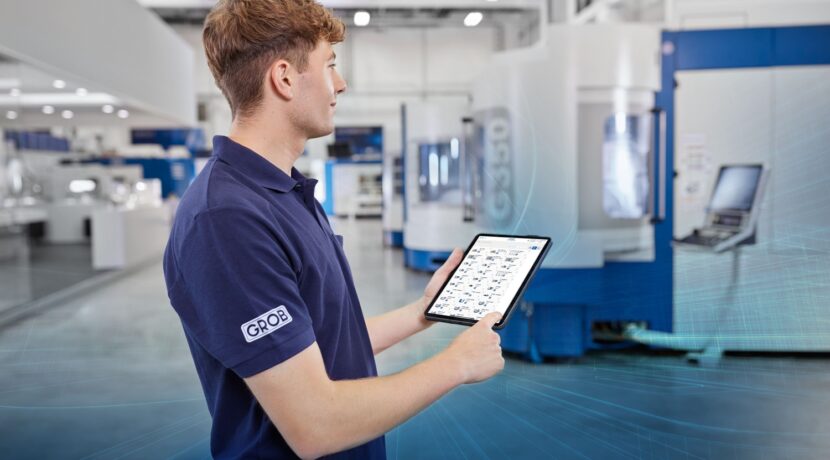
makes it possible to identify which processes create
bottlenecks, which sources of error most frequently reduce
machine availability, and what impact specific measures
have. (Picture: Grob-Werke)
Connecting older and newer machines
Grob-Werke’s approach illustrates the practical difficulty of collecting data from a mixed machine fleet. The Mindelheim-based manufacturer established its Grob-Net4Industry development department in 2013. Its first task was developing a connector. The connector had to interface directly with machine controls from different manufacturers and eras. The connector retrieves data down to programmable logic controller and numerical control variables. This includes data from machines whose controllers lack OPC UA interfaces. As a result, the company can access lower-level machine data. It does not depend on this communication interface being available on every control.
Grob makes the collected data available for further processing through a gateway. The gateway uses MQTT or OPC UA. For controls that cannot be networked, the company uses industrial PCs for data collection. According to Benedikt Gundling, product manager for digital products at Grob-Werke, retrofitting occurs during normal operation. It does not require intervention in the system or factory hall structure. Gundling says industry standardization initiatives such as umati are important. However, Grob also needed an approach for equipment accumulated over decades. The company first implemented its connector in its own production facility. It later offered the solution to customers.
Turning machine data into improvements
Connecting machines does not, by itself, improve plant effectiveness. The value of the data lies in making bottlenecks visible. It also helps identify recurring causes of lost machine availability. In addition, companies can check the effects of corrective measures. Gundling says efficiency gains of 8 to 15 per cent within a year are realistic in Grob’s experience. This applies when manufacturing actively uses a continuous improvement process. The figure is therefore linked to how the information is used. It does not result from data collection alone.
Cybersecurity and data control are also part of implementation. Grob says it applies security by design. It aligns its systems with EU regulations, including NIS-2 and the Cyber Resilience Act. The company also commissions external penetration tests. Depending on the product, its applications can operate on premises or in the cloud. For cloud applications, Grob says the connector processes data at the machine. Only defined machine data therefore leaves the factory. Grob also plans to show its Grob-Net4Industry digital products and Cosera manufacturing execution system at NexGeM.