
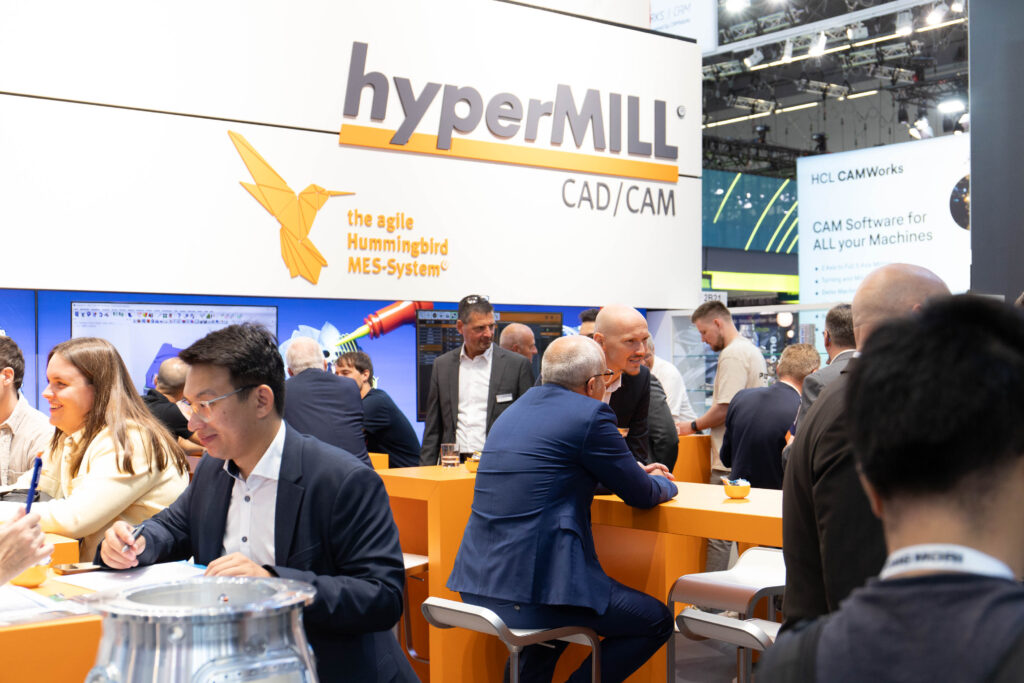
OPEN MIND reported strong interest in simulation, automation and manufacturing execution functions at AMB in Stuttgart. The company’s hyperMILL VIRTUAL Machining package was a central topic. Its simulation is based on actual NC code and machine data. Visitors also sought information on turning, automated CAM programming and centralized tool management. This interest reflects a practical concern in machining operations: verifying the process before an NC program reaches the machine. At the OPEN MIND stand, demonstrations focused on digital twins for complete machining processes.
According to OPEN MIND, the package simulates machining with the NC code that will be executed. It does not rely solely on an abstract toolpath representation. Alongside simulation, visitors examined functions designed to reduce programming effort. They also explored information flow between CAM programming and production management. hyperMILL TURNING Solutions and the Hummingbird Manufacturing Execution System attracted attention. Centralized tool management was particularly relevant for existing hyperMILL users.
Simulation based on machine data and NC code
The main interest at the stand centered on hyperMILL VIRTUAL Machining. Ales Vurusic, Central Region Sales Team Leader at OPEN MIND Technologies AG, explained the value of the system during a live demonstration. The simulation shows what is expected to happen on the machine. It uses machine data and the actual NC code. This approach is relevant for companies seeking greater confidence before machining starts. The package is intended to represent the complete machining process through a digital twin. Therefore, simulation is not treated only as a separate check during programming. OPEN MIND states that the approach helps protect both the workpiece and the machine. For users, the practical benefit lies in connecting the generated NC code with the simulated process. The closer this relationship, the more directly users can assess a planned machining operation. This aspect generated the strongest response among visitors at AMB.
Automation addresses programming bottlenecks
Existing hyperMILL users also explored automation options for CAM programming. The focus was on automating routine tasks. This is particularly relevant when work preparation limits throughput in programming and production planning. The information provided does not specify individual automation functions. However, visitor interest indicates that reducing recurring programming work remains important for CAM users. When routine activities can be automated, programmers can focus on tasks requiring direct technical assessment. This is especially relevant in companies where work preparation has become a bottleneck. Most visitors were primarily interested in NC code generation for milling. However, the workstation dedicated to hyperMILL TURNING Solutions also received considerable attention. This suggests that interest in the CAD/CAM suite extended beyond milling operations. The event also gave users an opportunity to compare programming and machining-related functions.
Central tool management links CAM and MES
The Hummingbird Manufacturing Execution System was another well-attended part of the presentation. Numerous visitors requested demonstrations and further information about the MES. Centralized tool management received particular attention from hyperMILL users. It provides a direct connection between programming and production execution. Visitors were interested in how a centralized MES function could support tooling information alongside their CAM work. As a result, the response at AMB showed strong interest in integrating these areas. Simulation, programming automation and manufacturing execution are increasingly being considered together rather than as separate topics.