
OPEN MIND Technologies will present its Hummingbird Manufacturing Execution System at AMB 2026 in Stuttgart. The system will be shown alongside the hyperMILL CAD/CAM suite. Hummingbird MES is designed for production environments with frequently changing orders, priorities and machine capacities. It is particularly suited to single-part and small-batch manufacturing, where maintaining an accurate overview can be difficult. The company will exhibit at booth 2B21 in Hall 2 from September 15 to 19.
Hummingbird MES uses a modular structure. This allows manufacturers to begin with one area of digitization while retaining a connection to a wider digital process chain. Its control concept is event-driven. Each time a part is manufactured, the production status is updated in real time for all users. Therefore, planners and operators receive current information for production planning, shop floor execution and operational decisions. OPEN MIND identifies four possible entry points: planning and control, CAM/CNC integration, tool logistics and machine data collection. Each addresses a different source of lost time, incomplete information or limited process visibility.
Planning linked directly to the shop floor
In dynamic manufacturing environments, planning can quickly become outdated. Jobs change, machines become unavailable and delivery dates shift. Hummingbird connects planning and shop floor activities in one digital system. Deviations are detected in real time and can be addressed through an agile planning board. This gives production planners visibility into the current situation. It also supports immediate adjustments when conditions change. For example, available machine capacity can be allocated differently to help maintain delivery dates.
Rather than treating planning as a separate, static process, the system links it to events in production. The event-driven approach also affects the status of individual parts. As parts are produced, their information is updated for all users. In single-part and small-batch production, routings, priorities and capacity requirements can vary between orders. As a result, planning decisions can be based on current production data rather than manually updated records. Companies can adopt this planning and control function independently. They can also connect it with additional MES functions later.
Digital transfer of CAM and CNC information
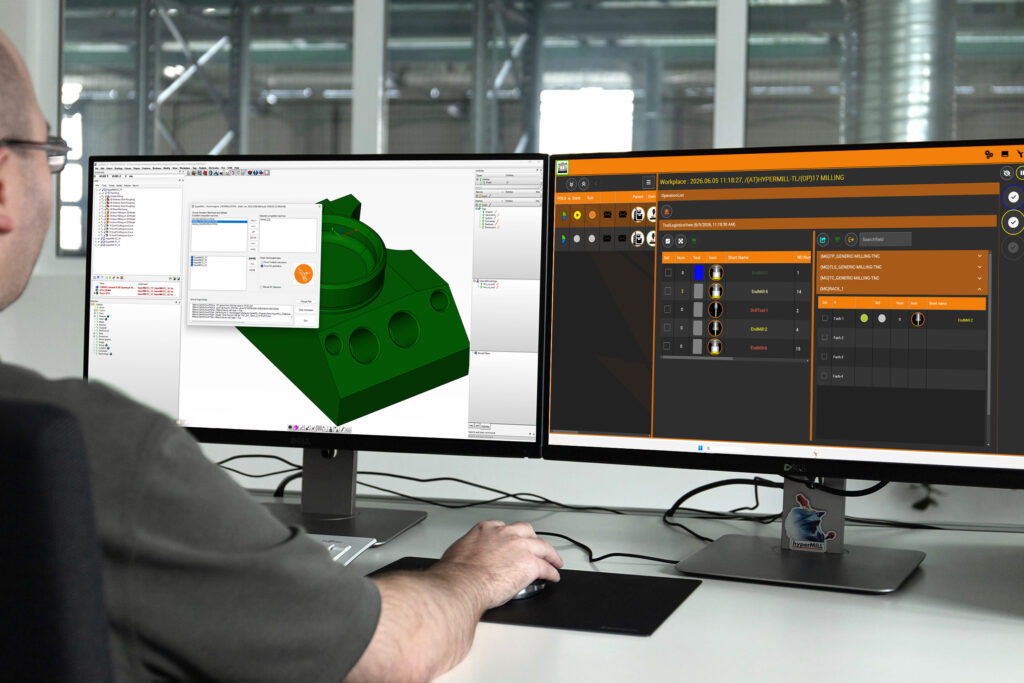
A second entry point connects CAM programming with machine execution. Hummingbird MES is integrated with hyperMILL. This integration enables the central management and versioning of CAM projects, NC programs, process data and tool data. The system transfers the required information from the CAM project to production without data loss. NC programs can be sent directly to production from the CAM project. At the machine workstation, operators receive the current NC program, setup information and job data. This creates a digital information package for the machining task. Operators do not need to obtain program, setup and process details from separate sources.
Version management is especially relevant when programs or process data change before production. The stated aim is to ensure that operators work with current information. They can therefore focus on executing the job. The MES extends beyond the transfer of an NC file. It connects programming data with the practical information required at the machine. This includes the relevant tool and process context.
Tool data and machine status in one system
Tool logistics is another area addressed by Hummingbird MES. OPEN MIND identifies tool searches, excess stock and premature tool changes as avoidable cost factors. The tool management function covers remaining tool life, tool measurement, and the storage and logistics of tools and holders. Machine operators can also record feedback when actual cutting parameters or tool life differ from planned values. This provides a way to capture deviations during machining. The information can then be made available within the digital process chain. Tool-related information is therefore not limited to planning data. It can also be linked to operational experience from the shop floor.
The fourth building block is machine data collection. It automatically gathers available data from connected machines and displays it in dashboards. The function analyzes machine and operational status, runtime and downtime in real time. It also generates and monitors key performance indicators. In addition, it supports the integration of different machine types. Within the broader MES structure, these data support the evaluation of machine utilization. They can also help identify opportunities for process adjustments.