
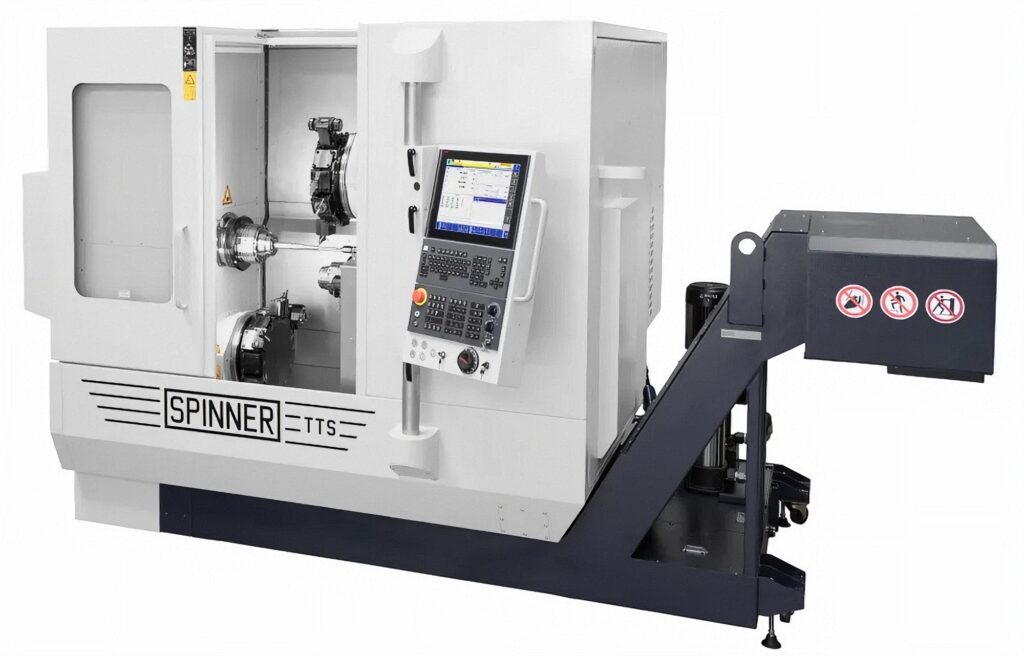
Spinner will present two additions to its TTS series at AMB 2026 in Stuttgart. The TTS36 and TTS52 are simultaneous turning machines for bar stock up to 36 and 52 mm, respectively. Both models combine two turrets, two motor spindles and a Y-axis in a machine length of approximately 2.4 metres. They target the complete machining of complex turned parts in short cycle times.
The new machines are intended for manufacturers combining turning and milling operations in one setup. Their configuration allows operations on the main spindle and sub-spindle to overlap. As a result, less of the cycle must be completed sequentially. Alongside bar work, the machines can also machine chucking components with diameters of approximately 200 mm.
Two turrets for parallel operations
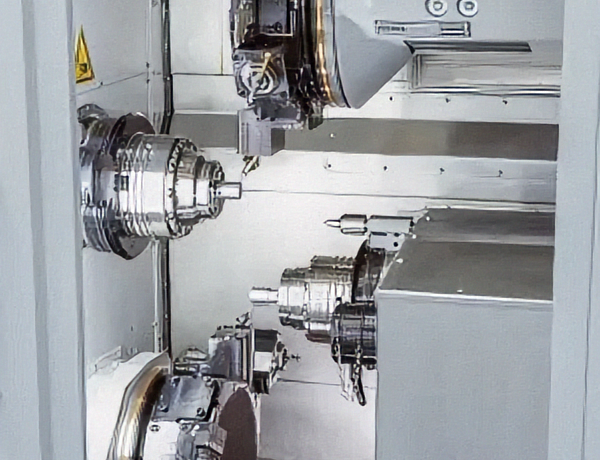
The TTS36 and TTS52 each have two turrets with twelve BMT45 tool stations. A dual-channel control system enables the turrets to operate independently. Therefore, different machining operations can run simultaneously on the main spindle and sub-spindle. For example, the sub-spindle can perform subsequent operations while machining continues on the main spindle. This is particularly relevant to series production and components requiring several turning and milling operations.
By running more process steps in parallel, the machine concept is designed to reduce cycle times. It also avoids transferring the workpiece between machines. The main spindle, sub-spindle and driven tools reach speeds of up to 10,000 min⁻¹. Both models include a Y-axis as standard. This extends the range of operations to eccentric milling and drilling. Moreover, the combination of turning, driven tooling and Y-axis machining supports the complete machining of parts with more complex geometries.
Compact layout with movable sub-spindle
Spinner has designed the TTS36 and TTS52 around a limited footprint. At approximately 2.4 metres long, the machines are relatively compact for their two-turret configuration. The machine bed is positioned at a 90-degree angle. This layout is intended to support chip evacuation while keeping the working area accessible for process monitoring and tool changes. The sub-spindle can move in the transverse direction. Its role is therefore not limited to taking over workpieces from the main spindle. This transverse movement also allows the machining of eccentric geometries.
In addition, the sub-spindle can be used as a tailstock. The main difference between the models is bar capacity. The TTS36 is designed for bar stock up to 36 mm. The TTS52 handles bar stock up to 52 mm. Both machines can also machine chucking components with diameters of approximately 200 mm. This broadens their application beyond bar-fed production.
Robot automation within the machine concept
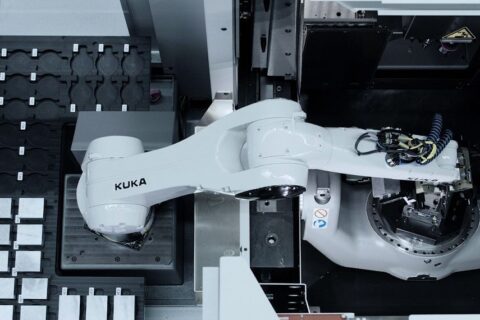
The TTS36 and TTS52 can be fitted with a six-axis robot integrated directly into the machine. The robot handles loading and unloading. This avoids the need for a separate automation cell next to the machine. This arrangement follows the compact approach of the series. Combining the machine and workpiece handling in one system limits the required floor space. It also supports repetitive production with a continuous workpiece supply. The automation is intended to minimise downtime between cycles. Loading and unloading would otherwise interrupt production. Spinner will offer the new models with either Siemens or Fanuc controls. The TTS36 and TTS52 will make their first public appearance at AMB 2026 in Stuttgart.