
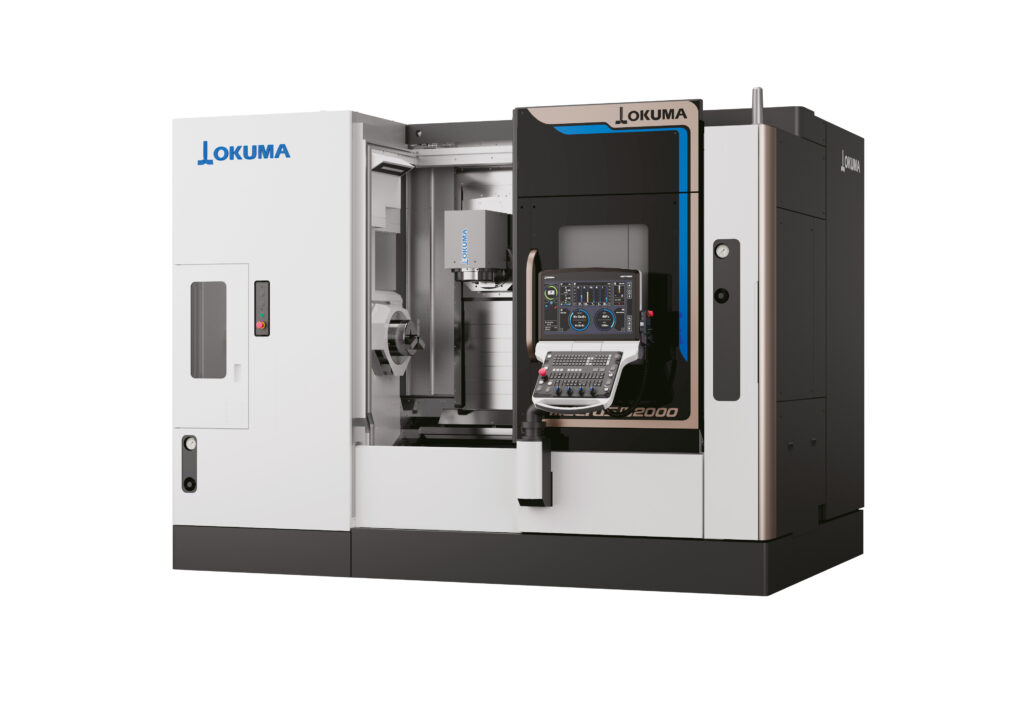
Okuma will present five CNC machine tools and several automation concepts at AMB 2026 in Stuttgart. The exhibits cover compact 5-axis machining, multitasking, automated turning and horizontal machining. Okuma will also show a new 3D programming function for its OSP control. The function aims to reduce programming effort directly at the machine.
The AMB presentation runs from 15 to 19 September in Hall 10, Booth E71. It focuses on combining machining capacity with automated material and pallet handling. The displayed systems address different production requirements. These range from single components and small batches to series production. Alongside machine kinematics and spindle performance, Okuma highlights several process stability factors. These include thermal compensation, collision prevention and vibration control. Moreover, several machines will feature integrated or connected automation. Applications include pallet handling, robot loading and extended unmanned operation.
Multitasking and 5-axis machining in compact installations
The new MULTUS U2000 multitasking machine combines a broad working area with a compact installation footprint. It supports complex 5-axis machining and two-saddle simultaneous turning. Its Turn-Cut function enables turning outside the rotation axis. Turning with the Y- and B-axes supports more stable cutting conditions. Simultaneous machining with the NC B-axis is also possible. The machine incorporates several Okuma technologies for consistent machining conditions. The Thermo-Friendly Concept compensates for temperature fluctuations during production. The Collision Avoidance System is designed to prevent collisions during cutting. Machining Navi automatically selects spindle speeds for low-vibration machining.
For simultaneous 5-axis work in a smaller space, Okuma will show the GENOS M460V-5AX. The machining centre handles workpieces up to 600 x 400 mm. Its automatic tool changer holds up to 48 tools. A double-supported trunnion table and double-column structure provide rigidity. The machine reaches feed rates of 32 m/min and spindle speeds of 15,000 rpm. At AMB, the machine will be paired with the UL-100 pallet handling system. The system stores up to eight zero-point pallets. It handles transfer weights of up to 100 kg. The arrangement therefore supports both automated and manual operation.
Automation options for turning and horizontal machining
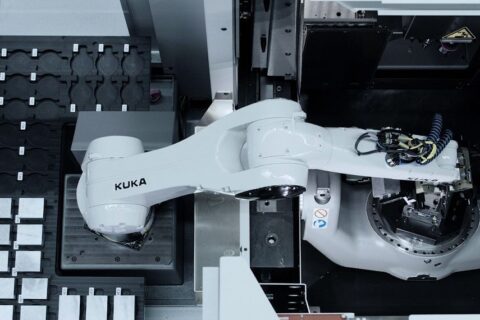
Okuma will also demonstrate several approaches to automated turning. The LB3000 EX III horizontal lathe has a twelve-position turret and a slant-bed design. At the exhibition, it will be shown with the integrated ARMROID robot arm. The arm loads and unloads workpieces and offers a large gripping range. According to Okuma, operators can set up and operate the automation without programming knowledge. This is relevant where operators must change jobs without developing separate robot programs. The LU4000 EX two-saddle CNC lathe is designed for cylindrical components. It supports simultaneous, synchronous 4-axis machining. The AMB configuration includes a Y-axis, driven tools and a sub-spindle. As a result, complex parts can be machined in one setup. For higher-volume production, the machine can be combined with robots, gantry loaders or bar feeders.
For horizontal machining, the MA-4000H will be displayed with a two-station pallet changer. The 4-axis machining centre has a 400 x 400 mm table. It also provides a large working area relative to its footprint. The pallet changer supports extended unmanned operation. Flexible manufacturing systems, additional pallet stations and robots can be added for more autonomous production.
3D programming directly on the machine control
Another focus at AMB will be the new 3D-Direct programming function for the OSP control. The system was developed for European markets. It enables operators to program operations directly on the touchscreen using 3D data. STEP files can be imported, and the control retrieves tool data from the OSP system. The function covers face, contour, pocket and chamfer milling. It also supports drilling and tapping. Based on the imported geometry, the control suggests machining strategies. This is intended to reduce the workload involved in programming complex geometries at the machine. Initially, 3D-Direct will be available for vertical machining centres. Expansion to other machine types is planned.