
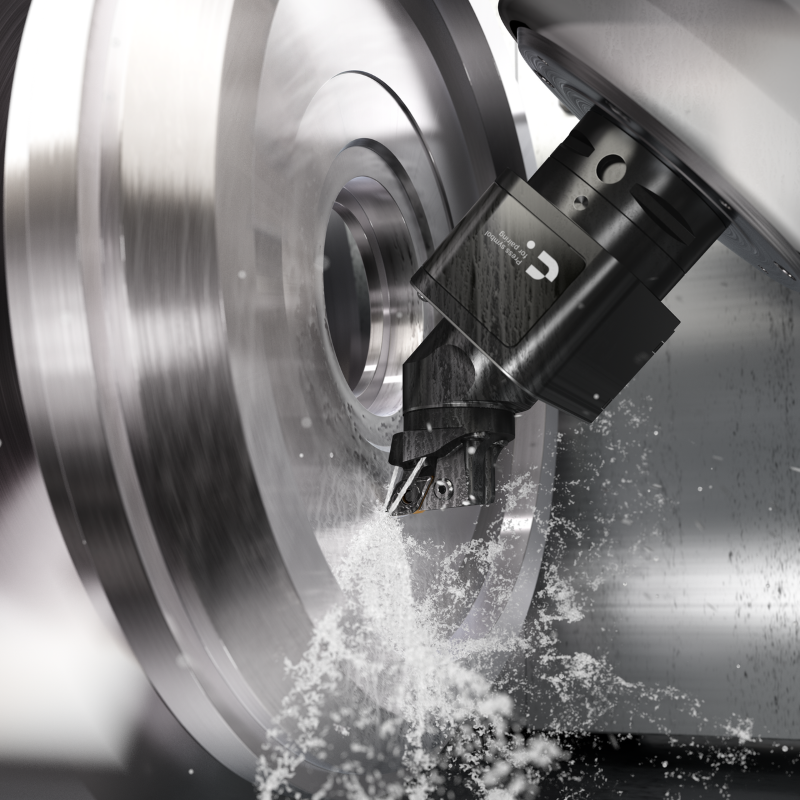
Sandvik Coromant has introduced CoroTurn Plus, a sensor-equipped turning adapter that makes cutting forces, chatter, vibration, and in-cut status visible in real time. The system is aimed at manufacturers that want more stable turning processes, fewer scrap parts, and a clearer route toward automated or unattended machining within defined process limits.
Turning operations often depend on signals that are difficult to see while the process is running. Tool wear, material variation, and unstable cutting conditions may only become visible after a component is measured, scrapped, or reworked. CoroTurn Plus addresses this gap by bringing live process data from the tool into digital systems that operators and machine controls can use.
The concept combines sensor-equipped tooling with two levels of digital functionality. With CoroPlus Viewer, the data supports operator decisions through real-time visualization. With CoroPlus Connected, the same signals can be used for machine-integrated protective actions through the NC. This distinction is important for production teams because it separates monitoring from automated response and allows companies to scale their use of the technology according to process requirements.
Real-time visibility for operator decisions
When used with CoroPlus Viewer, CoroTurn Plus streams live cutting data to a PC or tablet. Operators can follow the process while it is happening, rather than relying only on inspection results after machining. The system visualizes cutting forces, chatter, vibration, and in-cut status, giving the operator a clearer basis for intervention when values move beyond defined thresholds.
The practical value lies in the combination of live monitoring and traceable process information. Audible alarms warn when threshold values are exceeded, while operators can inspect values, evaluate deviations, and mark events for later analysis. This supports faster root-cause work when a batch shows variation or when a tool behaves differently from a known reference process.
Tool condition is another area where live data can be useful. As more tool-condition signals are collected, teams can identify when an insert is approaching the end of its life and replace it at the right time. In practice, this can help extend tool life without increasing the risk of unplanned downtime or damaged components. For production environments where consistency is critical, the ability to compare actual cutting behavior against reference processes can also support continuous improvement.
Machine-integrated response through the NC
For applications that require more than visualization, CoroTurn Plus can be connected to CoroPlus Connected and integrated with the machine’s NC. In this configuration, users define threshold values for vibration, load, and chatter in the software or through NC code. If an unexpected event occurs, the control can initiate protective interrupting actions to safeguard the workpiece, tool, and equipment.
These actions are configured by the end user, which keeps the automated response within defined limits. According to Sandvik Coromant, the control can make protective decisions, stop, retract, and resume within these limits. This is relevant for manufacturers looking to increase machine utilization, particularly during unattended evening or night shifts, where the ability to react to abnormal cutting conditions becomes a key requirement.
The system also includes feed and cutting speed override configurators. This allows optimization within the process rather than treating monitoring as a separate activity. Data tracked for component position adds further diagnostic value, helping teams connect a deviation to a specific pass or feature. For day-shift production, the same functionality can reduce interruptions by allowing routine decisions to be handled more consistently by the machine control.
Traceability across batches and components
Beyond immediate process control, CoroTurn® Plus stores and documents cutting data for each pass. This gives production teams a structured way to compare batch performance, identify material deviations, and maintain documentation for end customers. For components such as discs, housings, shafts, pumps, and valves, this traceability can support both internal quality work and external certification requirements.
The system includes industrialized functions intended to make the data flow part of normal production rather than a separate test setup. These include automatic coupling and uncoupling of the bar, ready-to-machine system checks, starting and stopping data logging, and notifications when the system is not available. Such functions matter because automation depends not only on sensors, but also on reliable routines around setup, status checks, and data capture.
Åke Åxner, Global Project Manager, Machine Integration at Sandvik Coromant, said the system turns hidden behavior in the cut into clear signals, making it easier to recognize material variations, tool wear, and instability as they occur. Leland Bailey, Project Manager at Sandvik Coromant, described sensor-equipped tools as a practical bridge to more advanced automation because they connect cutting signals directly to safe, machine-enforced actions.
From signals to controlled automation
The release of CoroTurn Plus reflects a practical step in turning automation: using data from the cutting zone to support decisions at both operator and machine level. In its passive form, the system gives operators clearer visual cues and alarms. In its integrated form, it enables the NC to respond to defined events through configured protective actions.
For manufacturers, the main relevance is process stability. Live data can help reduce uncertainty around tool wear, material behavior, and chatter, while documented cutting information supports repeatability and traceability. When combined with NC-level integration, the same signals can help machines operate for more effective hours within defined safety limits, especially when staffing is limited or production continues outside normal daytime shifts.