
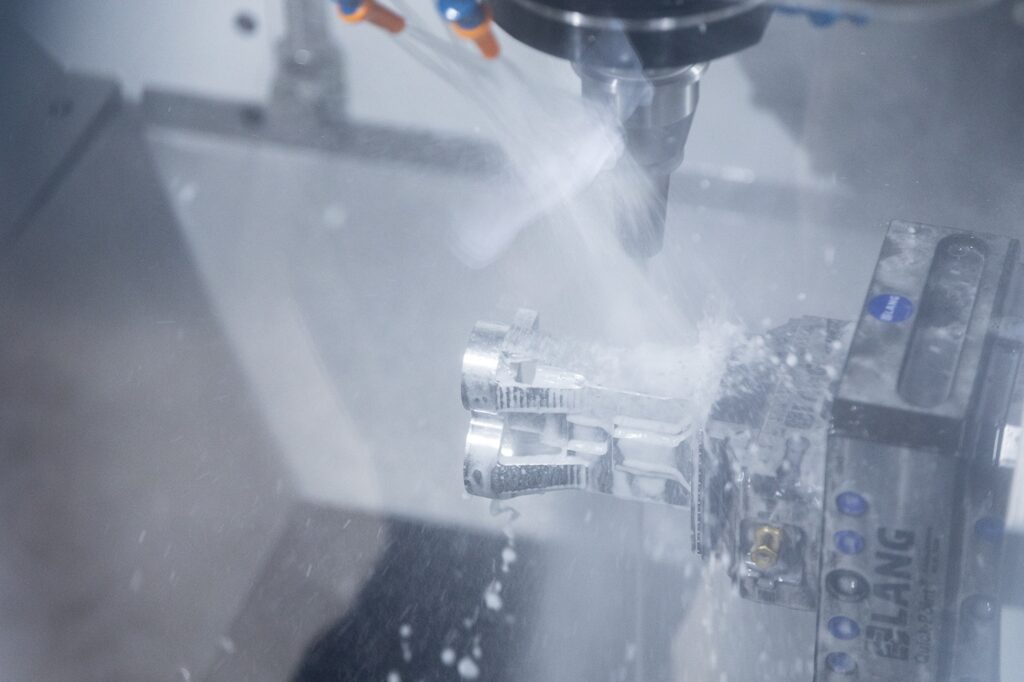
MIKRON MILL showcased four machined components at JIMTOF 2026 to demonstrate different milling strategies and machining challenges. A vision module housing, a reflector mold and two medical parts illustrated how tool selection, machining sequence and machine dynamics affect surface quality, accuracy and repeatability when producing complex geometries.
The display included an aluminum vision module housing with conical bores, freeform surfaces and thin ribs. Machined on a MILL S 600 U in two setups, the component required approximately 32 minutes of machining time. A reflector mold demonstrated the challenges of using small, long tools, which can be susceptible to deflection and vibration. The two medical components, a spinal implant and a fracture fixation plate, combined freeform geometries with tight tolerances and demanding surface requirements. For these applications, dimensional accuracy and surface quality directly affect implant fit, performance and validation. The four components were presented at the MIKRON MILL booth in Hall EAST 8, where the company highlighted its approaches to precision machining.
Machining the vision housing in two setups
The vision module housing measures 97 x 90 x 50 mm and is made from AW-6082 aluminum. It includes two conical bores, freeform outer surfaces, pockets, drilled and threaded features, and thin ribs. Machining required 12 tools, including one with a diameter of just 2 mm.
The machining sequence was planned around the part’s rigidity. After initial roughing, the two upper cylindrical contours were finished before most of the surrounding material was removed. Keeping more material in place at this stage reduced the risk of vibration affecting these surfaces.
For the conical bores, an 8 mm barrel mill with a 250 mm radius enabled a large depth of cut while producing a fine surface finish in a five-axis operation. The outer freeform surfaces were finished using simultaneous four-axis motion with a 3 mm ball end mill running at 36,000 rpm. The toolpath mainly consisted of linear movements and short C-axis rotations, helping maintain smooth motion and high feed rates. Small tools completed the finishing operations and five-axis deburring inside and outside the housing.
Surface quality and repeatability
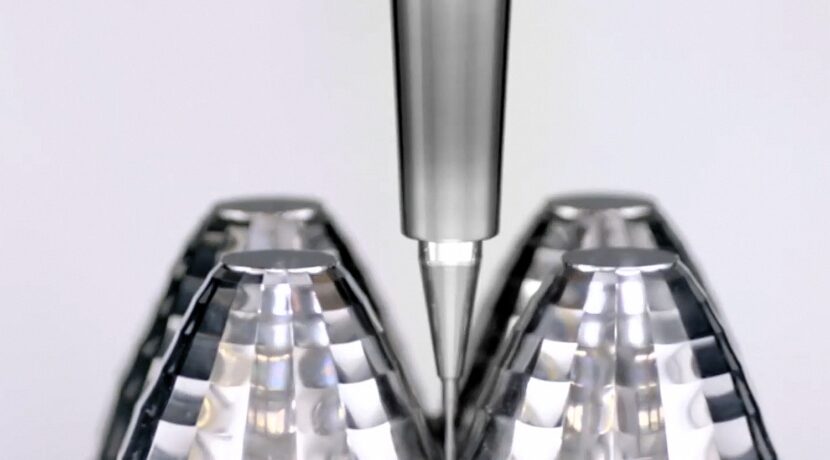
The reflector mold demonstrated a different machining challenge. Small, long tools can deflect or vibrate during machining, potentially leaving marks on the finished surface. MIKRON MILL attributes process stability in this application to the machine structure and its STEP TEC spindle. The ITC system controls thermal behavior during long machining cycles, while OSS supports setup and processing. The company also identifies ISM as a system for maintaining consistent surface quality from one part to the next.
For the medical components, precise movement along complex contours is essential. Direct torque motors drive the rotary and tilting axes without mechanical transmission, eliminating transmission backlash and wear. Linear drives provide fast axis response, allowing the machine to follow curves, transitions and small radii at high feed rates.
Automated Machine Calibration recalibrates the five-axis kinematics in minutes, while ITC controls thermal drift. Together with the rigid machine structure and spindle, these systems are designed to maintain dimensional accuracy and surface finish throughout a production run. For medical manufacturers, consistent machining results can reduce manual rework and support the repeatability required in regulated production.