
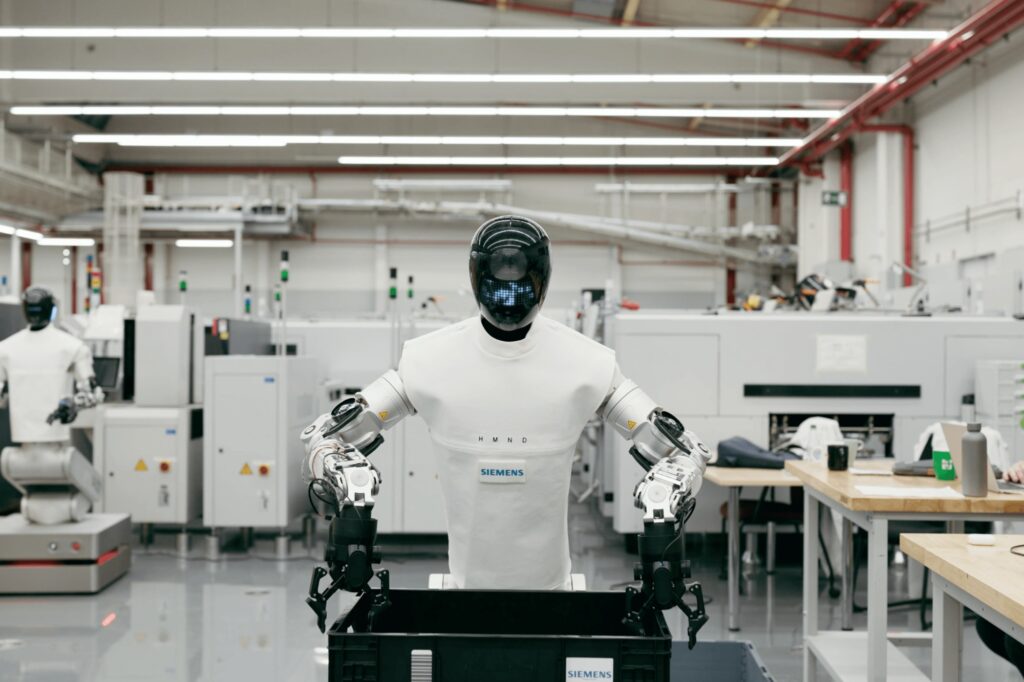
Siemens, Humanoid and NVIDIA have moved humanoid robotics from demonstration to factory logistics with a test at Siemens’ electronics factory in Erlangen, Germany. The HMND 01 Alpha robot autonomously handled totes for human operators, meeting stated targets for throughput, uptime and pick-and-place success. For manufacturers, the test is relevant because it links robot autonomy with industrial integration.
The project builds on the strategic partnership between Siemens and NVIDIA, announced at CES, to develop fully AI-driven, adaptive manufacturing sites. In this case, the focus was not a general robotics showcase, but a defined logistics task inside an operating industrial environment.
Humanoid’s HMND 01 Alpha is a wheeled humanoid robot built for industrial use. It combines omnidirectional mobility with manipulation capabilities and uses NVIDIA’s physical AI stack for simulation, training and edge computing. Siemens supplied the industrial integration layer through its Siemens Xcelerator portfolio, including digital twin capabilities, AI-enabled perception, PLC and robot interfaces, fleet management, industrial networks and drives.
The result is a useful indication of where humanoid robots may first enter production environments, not as stand-alone machines, but as connected assets that interact with existing workflows, equipment and operators.
Autonomous tote handling in live logistics
The robot was deployed in Siemens’ logistics operations in Erlangen, where it picked, transported and placed containers for human operators. According to the companies, the system achieved 60 tote moves per hour, uptime of more than eight hours and autonomous pick-and-place success rates above 90 percent.
Those figures matter because factory logistics often depends on repetitive handling work that must be reliable over a shift, not only during a short demonstration. Throughput shows whether the robot can support a practical material flow. Uptime indicates whether the system can remain available long enough to fit into production operations. The pick-and-place success rate gives a first view of how consistently the robot can complete manipulation tasks without manual intervention.
The application is also significant because tote handling involves more than moving from point A to point B. The robot has to locate containers, interact with them physically, transport them safely and place them where operators can continue their work. That combination of navigation and manipulation is central to the value of humanoid systems in human-oriented factory spaces.
Integration as the factory backbone
A humanoid robot only becomes useful in production when it can work as part of the wider automation environment. The press release points to real-time data exchange with production systems and other autonomous guided vehicles, synchronized workflows with machines and human operators and adaptive behavior when conditions change.
This is where Siemens positions its Xcelerator portfolio. The integration layer includes digital twin technology, AI-enabled perception, control and PLC-robot interfaces, fleet management, industrial communication networks and high-performance drives. In practical terms, these elements determine whether a humanoid robot can be managed like an industrial asset instead of treated as a separate experimental system.
For manufacturers, this distinction is important. A robot that cannot exchange data with existing systems may still perform an impressive movement, but it remains isolated. In contrast, a connected robot can be included in production planning, logistics coordination and operational monitoring. That reduces friction for deployment and makes it easier to align autonomous actions with factory requirements such as material availability, operator workstations and machine schedules.
Simulation and edge AI shorten development
Humanoid integrated NVIDIA’s physical AI stack into the HMND 01 platform. The setup includes NVIDIA Jetson Thor for edge computing, NVIDIA Isaac Sim for simulation and NVIDIA Isaac Lab for reinforcement learning and policy training.
The companies state that simulation-first hardware design helped optimize actuator selection, joint strength and mass distribution before physical prototypes were built. Prototype development was reduced from a typical 18 to 24 months to seven months. For a robotics platform intended for industrial work, this development step is not only about speed. Virtual testing can help teams assess mechanical choices earlier, compare design alternatives and reduce the number of costly physical iterations.
Edge computing is also relevant once the robot enters the factory. Tasks such as perception, motion decisions and manipulation cannot depend solely on offline planning. The robot must process information close to the machine and respond to changing conditions while maintaining coordination with the production environment. That is one of the core challenges behind physical AI, training machines not just to recognize the world, but to act within it.
Built for industrial human spaces
Humanoid, founded in the United Kingdom, developed the HMND 01 Alpha specifically for industrial environments. The robot uses a wheeled omnidirectional platform rather than legs, a design choice that suits factory floors where stable movement and efficient transport are central. Its manipulation capabilities are intended for tasks in spaces already designed around human operators.
The platform is powered by KinetIQ, Humanoid’s proprietary AI framework. According to the company, the robot is designed to adapt to varied tasks and handle complex actions. In the Erlangen test, that translated into a logistics workflow with containers, operators and existing production infrastructure.
The broader relevance lies in task flexibility. Traditional automation performs best when operations are highly structured and repeatable. The value proposed for humanoid systems is different, the ability to operate in environments where workstations, containers and human activity create more variation. The Erlangen deployment does not answer every question about scale, safety or long-term economics, but it does show how industrial humanoids are beginning to be evaluated against measurable factory tasks rather than isolated laboratory benchmarks.