
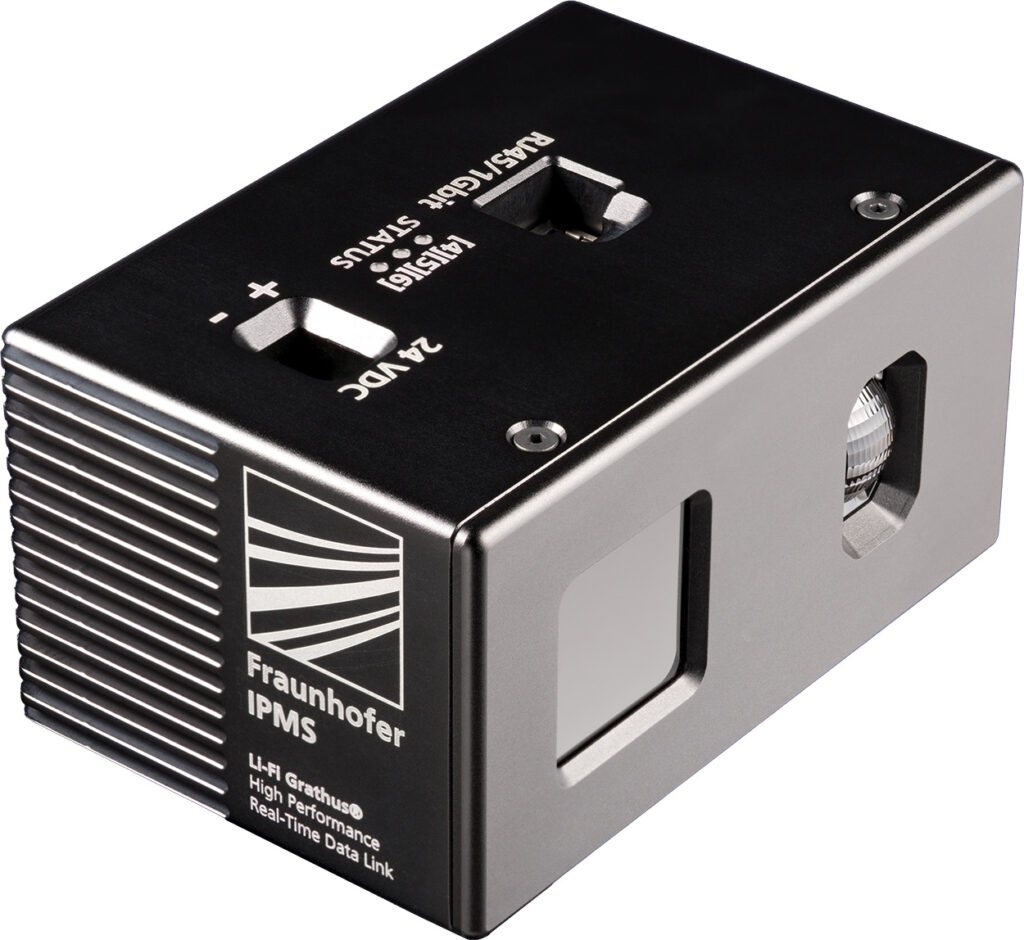
Fraunhofer IPMS has presented Li-Fi Grathus, an optical wireless communication system for industrial environments. The technology is designed to deliver gigabit data rates, simultaneous send and receive operation, and deterministic latency below 100 nanoseconds. That combination is relevant for applications where conventional radio links are vulnerable to interference and cables limit machine design or retrofitting.
Industrial communication increasingly has to combine speed, stability, and flexibility. In practice, that is not always straightforward. Wired connections remain dependable, but they can be restrictive when machines move, rotate, or are frequently reconfigured. Wireless alternatives based on radio are easier to deploy, yet metallic surroundings and electromagnetic interference can undermine reliability. Fraunhofer IPMS positions Li-Fi Grathus as an answer to that gap. The system transmits data via light rather than radio waves and reaches data rates of 1 Gbit/s or more over distances of up to 10 meters. According to the institute, the technology is intended for communication between machines, sensors, actuators, and control systems in environments where both real-time behavior and robustness matter.
Deterministic communication without radio interference
The central technical feature of Li-Fi Grathus is its deterministic latency of less than 100 nanoseconds. For industrial users, that matters most in control tasks where timing must not only be fast, but also predictable. Robotics, motion control, and tightly synchronized machine processes depend on communication that behaves consistently under load. Fraunhofer IPMS states that the optical link can transmit and receive simultaneously in full-duplex mode, avoiding interruptions in data flow and reducing time loss between both directions of communication.
Because the system uses light signals instead of radio waves, it is not affected by electromagnetic interference. That can be a decisive advantage in production areas with drives, motors, switching equipment, or dense metal structures, where radio systems often struggle. The institute also states that Li-Fi Grathus can be integrated into existing networks without major modifications. Support is provided for industrial standards including Profinet, EtherCAT, EtherCAT G, SERCOS III, and TSN. In addition to Ethernet and Gigabit Ethernet, the system supports USB 3.0 and 3.1, as well as customer-specific interfaces. A separate 1 Mbit/s side channel is available for management, diagnostics, and safety-related signals.
Practical installation and industrial design
Fraunhofer IPMS places clear emphasis on usability in industrial deployment. Optical transmission systems are often associated with careful alignment and sensitive setup procedures, especially in free-space configurations. Li-Fi Grathus is intended to avoid that barrier. According to the institute, the system can be installed and operated without adjustment, which simplifies commissioning in practical machine environments. A patented multi-path lens is designed to allow higher transmission power while keeping manual alignment simple.
The hardware is also built around industrial handling requirements. Fraunhofer IPMS describes the system as thermally stable, compact, and plug-and-play, with a metal housing for use in demanding environments. Laser Class 1 operation is intended to ensure eye-safe use. These points are especially relevant where wireless links are added to existing systems rather than designed in from the start. In retrofit scenarios, easy installation and robust packaging often determine whether a new communication method can realistically be adopted on the shop floor. Fraunhofer IPMS also sees potential in applications such as logistics systems, shelving and warehouse solutions, large rotating machinery, and high-bandwidth sensor data transfer in automated guided vehicles.
Evaluation kit for testing in existing systems
The technology is available as an evaluation kit aimed at practical validation. Fraunhofer IPMS says the kit can replace a wired 1 Gbps Ethernet connection with an optical plug-and-play link, allowing users to test the basic functions in their own environment. The package includes two Grathus modules, two Ethernet cables, a power supply, and a user manual.
For the evaluation kit, Fraunhofer IPMS specifies a range of up to 5 meters with high dynamic range. Other stated characteristics include bidirectional full-duplex communication, data rates of 1 Gbps and above, and compatibility with Profinet, EtherCAT, EtherCAT G, and SERCOS III. The module dimensions are 79 x 119 x 62 mm. With this format, the institute is not only presenting a communication concept, but also a testable platform for users assessing whether optical wireless links can take over tasks that are difficult to solve with either cable or radio.