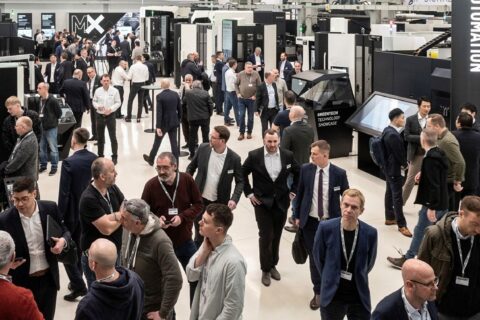

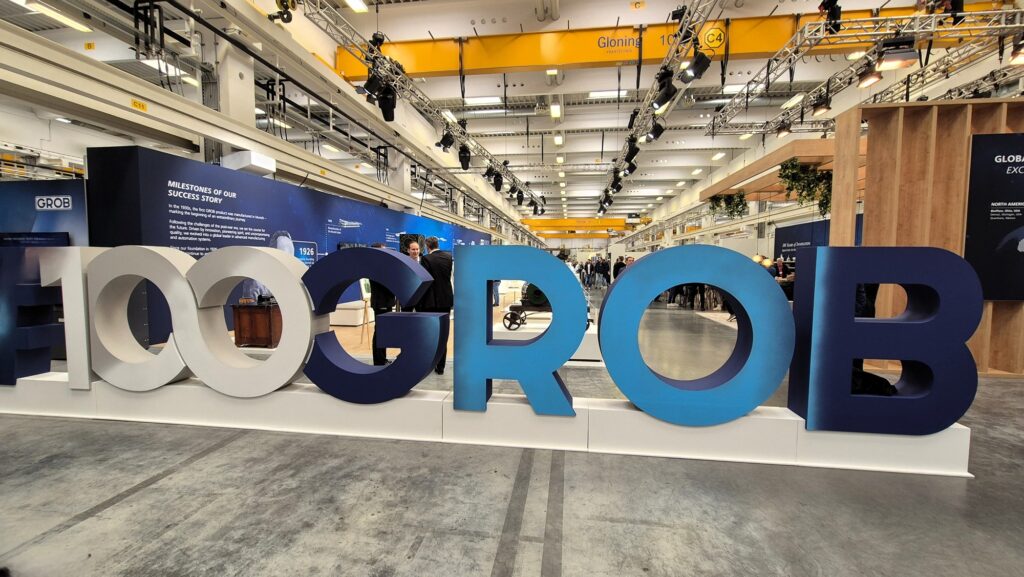
At its 2026 open house in Mindelheim, GROB combined its 100 year anniversary with an extensive presentation of new technologies and production capabilities. The event, held from 17 to 20 March, offered visitors the opportunity to see more than 40 machines in live operation, ranging from universal machining centres and solutions for cutting technology to systems for electromobility and additive manufacturing. At the same time, the company introduced three premieres that underline its strategic direction in machining, automation and digital manufacturing.
The scale of the event reflected GROB’s position as a fully integrated machine builder. More than seventy guided tours across fourteen production halls provided detailed insight into manufacturing depth and process expertise. Four dedicated special areas focused on current growth markets, semiconductor, aerospace and defence, energy technology, and die and mold. Together, these elements created a comprehensive overview of both existing capabilities and future developments within the company.
Large format machining with portal concept
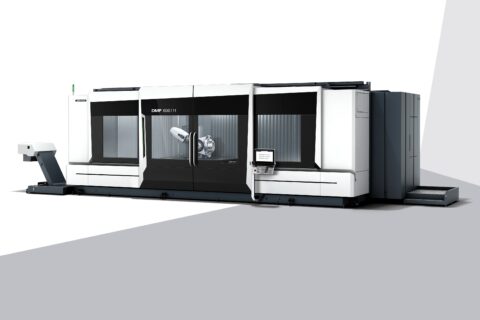
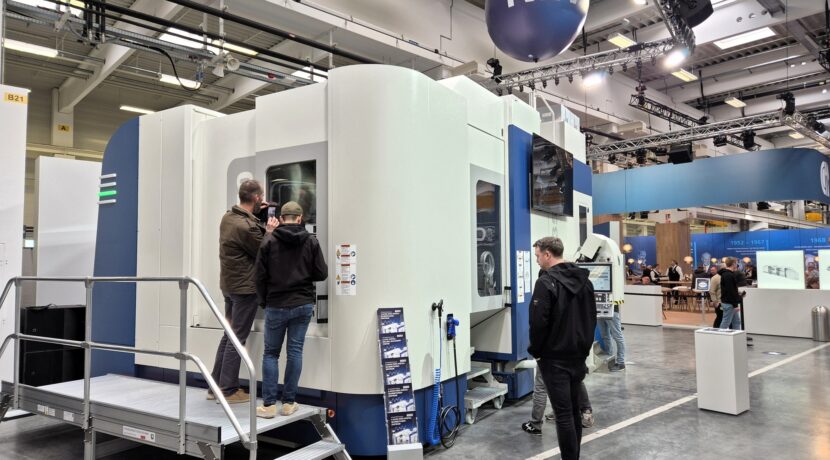
One of the most prominent premieres was the GP1350, a 5-axis portal milling machining centre developed for large and complex workpieces. According to GROB, the machine occupies a unique position in the market due to its size and configuration. It is designed to address manufacturing tasks that increasingly require the combination of large component dimensions, complex geometries and high accuracy.
The machine offers travel distances of 1,400 mm in the X-axis, 1,950 mm in the Y-axis and 1,100 mm in the Z-axis. This enables the machining of components with maximum dimensions of 1,400 x 1,100 mm or 1,750 x 1,600 mm. With a maximum payload of 3.6 tonnes, the GP1350 is capable of handling heavy and large-format parts without compromising stability.
A key feature is the large tool magazine, which can accommodate up to 408 tools. The use of a double-row arrangement allows multiple tools to be prepared simultaneously, contributing to more efficient setup processes. The universal milling head, featuring an undercut capability of minus 2.5 degrees, extends machining flexibility and reduces the need for repositioning or additional setups.
The portal design itself provides a rigid and stable structure, which is essential for maintaining accuracy when machining large components. At the same time, GROB has focused on keeping the machine footprint compact relative to its working envelope, allowing integration into production environments where space remains a limiting factor.
Automation was presented as an integral part of the GP1350 concept. The machine can be equipped with pallet changers, pallet storage systems and autonomous mobile robots for loading. This allows manufacturers to configure the system for a wide range of production scenarios, from single-part manufacturing to high-volume series production. The combination of powerful spindles, dynamic axis movements and a robust table enables the machining of a broad range of materials under economically viable conditions.
Modular automation for series production
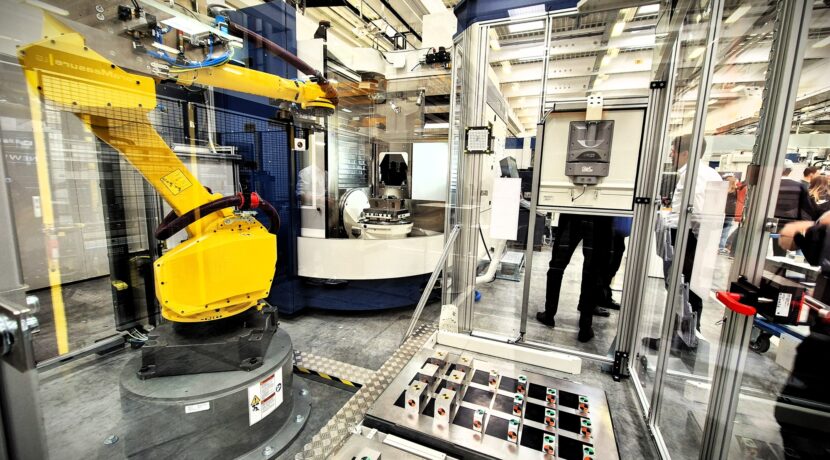
The second premiere at the open house was the GRC-M60 robotic cell, which represents a further step in GROB’s automation strategy. The system is designed as a standardized yet flexibly configurable solution for series production, with a clear focus on increasing output, reducing unit costs and enabling continuous production processes.
The GRC-M60 can be connected to either one or two 5-axis universal machining centres. It is compatible with the G150, G350a and G350 models, allowing users to adapt the system to different component sizes, batch sizes and production strategies. This flexibility is a central aspect of the concept, as manufacturers increasingly require scalable automation solutions.
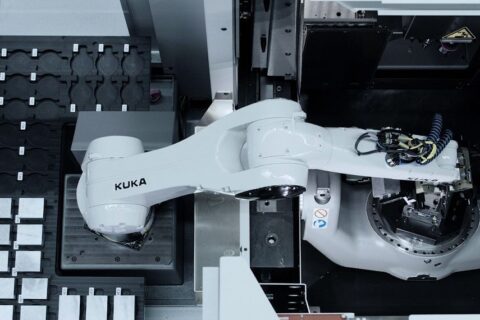
At the core of the cell is a six-axis industrial robot from FANUC, equipped with either a fixed single or double gripper. In combination with integrated camera technology, the system ensures precise positioning of workpieces on both rolling carts and Euro pallets. This contributes to reduced non-productive time and increased process reliability, particularly during extended periods of unmanned operation.
The material supply system is modular and can be configured with one, two or four loading positions, depending on production requirements. Users can choose between Euro pallets and rolling carts as standard options, while a drawer module is available as an additional configuration. This modular approach allows the system to be tailored to the specific mix of parts and production volumes.
Despite its flexibility, the GRC-M60 is designed with a compact footprint, enabling integration into existing production environments where available space may be limited. The system is intended to support higher output per day while reducing the need for manual intervention.
A central component of the robotic cell is the GROB4Automation control software. This system provides a visual interface for organizing production orders and supports integrated job planning directly within the automation environment. The goal is to extend unmanned production times while maintaining full transparency over ongoing processes. The user interface is designed to be intuitive, with structured workflows that reduce setup effort and contribute to stable, repeatable series production.
Digital production control with COSERA
The third premiere focused on digitalization with the introduction of COSERA, a Manufacturing Operations Management system developed by GROB. The software is positioned as a central control system for the entire shop floor, integrating machine data, process monitoring and production planning into a single platform.
COSERA is based on the idea of combining GROB’s accumulated process knowledge with modern software architecture. A key aspect of the system is its direct integration with SAP, allowing companies to use existing security standards and ensuring seamless connectivity between enterprise systems and shop floor operations. This integration enables real-time availability of production data across the entire organization, including on mobile devices, which can significantly reduce response times in manufacturing.
Another defining feature of COSERA is its open architecture. Unlike many conventional MES solutions, the software code is accessible and can be modified by the user. This allows companies to adapt the system to their specific production processes and requirements, rather than relying on predefined structures. The system is installed directly at the customer’s site, ensuring full control over data and system configuration.
In addition, COSERA is designed for cross-manufacturer connectivity. It is capable of integrating not only GROB machines but also equipment from other suppliers into a unified data environment. This creates a consistent data basis for analysis and optimization across the entire production system.
The presentation of COSERA during the anniversary open house highlighted the increasing importance of digital systems in manufacturing. Alongside machining technology and automation, software is positioned as a key element in achieving transparency, efficiency and control in modern production environments.