
During a multi-day customer journey along several production sites in southern Germany and Austria, Ceratizit opened the program at its renovated Technical Center in Kempten. The focus there was not on the factory itself, but on the question of how tools perform in practice. Live demonstrations showed how geometry, feed rate and material behavior directly affect tool life, dimensional accuracy and process reliability.
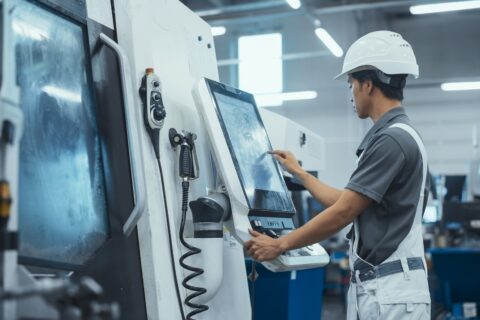
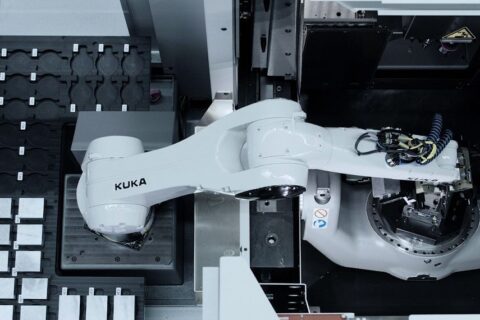
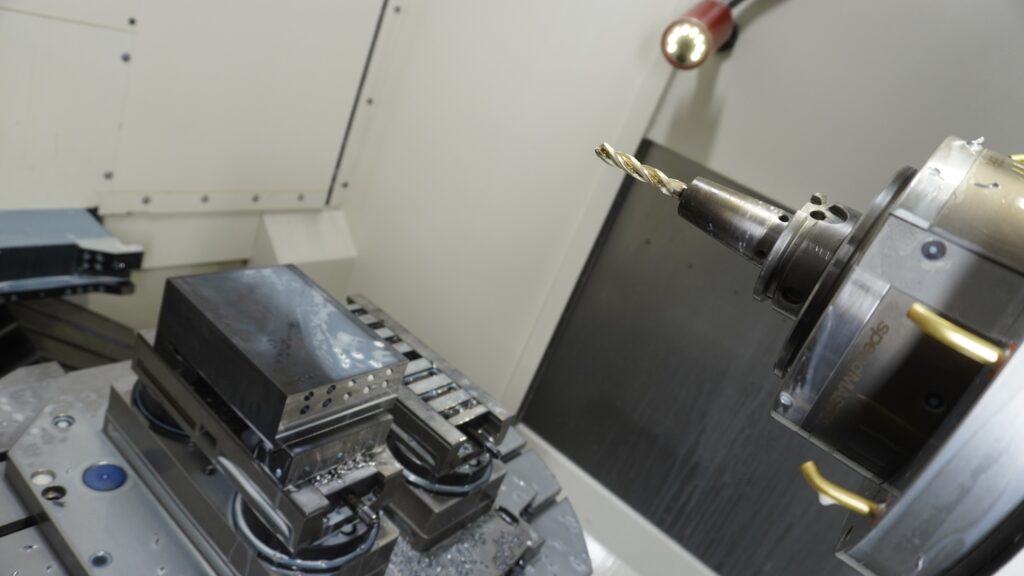
At the Technical Center, Ceratizit immediately established the link between development and machining practice. On a five-axis machining center from DMG Mori and a turning center from Emco, various turning, milling and drilling concepts were demonstrated live under real cutting conditions. This made it clear how strongly the performance of a tool depends on the combination of cutting-edge geometry, coating, cooling strategy and application. For the visitors, it was especially relevant that these technical choices did not remain abstract, but became directly visible in the machining process itself.
Three drill concepts, three production strategies
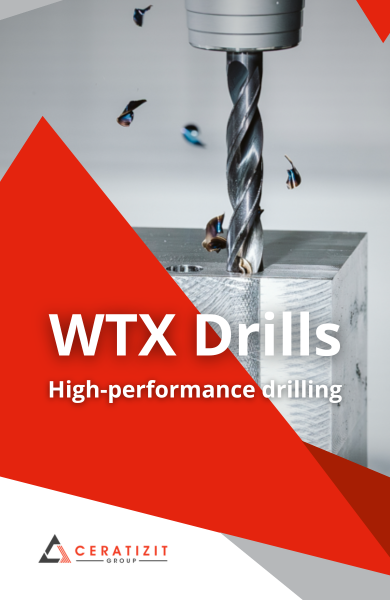
One of the most compelling parts was the comparison between three solid carbide drill concepts that look very similar in appearance, but each supports a different production strategy. The WTX Uni Quattro showed how stability and positional accuracy come together in applications where process reliability is central. The WTX Feed was clearly aimed at very high feed rates and shorter cycle times. The WTX Speed demonstrated its strength in universal applications with high cutting speeds in steel, stainless steel and cast iron. This made it clear that the choice of a drill goes far beyond diameter or workpiece material alone. As Abram Schut, sales manager at Ceratizit, summarized it, the match between geometry, material and machining objective ultimately determines performance.
Modular drilling for lower tooling costs
The modular WTX Change also attracted a great deal of attention. On the Emco turning center, it became visible how Ceratizit uses exchangeable-head drills to combine performance, flexibility and lower tooling costs. The WTX Change couples a solid carbide drill head to a steel holder, so that only the head needs to be replaced or reground. This significantly reduces the cost per hole, especially in series production where tool changes occur frequently.
From a technical standpoint, this system stands out primarily because of the clamping mechanism through a serration between holder and head. This serration creates a large contact area, increases torsional stiffness and ensures highly stable power transmission during drilling. The direct result is high runout accuracy and repeatability, even at higher feed rates. Particularly with exchangeable-head and indexable-insert drills, such stable clamping is crucial, because even minimal deviations directly affect dimensional accuracy, coaxiality and tool life.
Micro deep-hole drilling under control
In addition, with the WTX Micro, Ceratizit showed that the company does not limit itself to standard operations. These solid carbide drills, available in diameters from 1.0 to 2.9 mm, were developed for micro deep-hole drilling up to 30xD. It is precisely in that range that chip evacuation, heat generation and stability become critical factors. During the demonstration, it became clear how the special point geometry, polished flutes and internal coolant channels along the full shank length contribute to a stable process, including in difficult materials such as stainless steel.
For visitors, the demonstrations made clear how important cutting edges, geometry, coatings and internal coolant channels are for tool life, chip evacuation, dimensional accuracy and process reliability. As a result, the visit to Kempten gained significance above all as a technical deepening of what truly determines tool performance in practice.