
Medical technology is creating new opportunities for grinding specialists, but the demands are unusually high. Surface quality, fit, reproducibility and traceability all have direct implications for product function and regulatory compliance. As manufacturers seek both efficiency and greater product variety, the focus is shifting from individual machines and tools to coordinated grinding processes across the full production chain.
That shift reflects a market that continues to grow. In Germany, medical technology is expanding by around 5 per cent a year, with roughly 68 per cent of revenue generated through exports. At the same time, entry barriers remain high because of the European Medical Device Regulation, which raises expectations for documentation, process reliability and quality assurance. For grinding technology suppliers, this creates a demanding but attractive field of application. The range of products is also exceptionally broad. According to estimates by the Federal Ministry of Health, around half a million different medical products are currently in circulation. That diversity translates into a wide spread of component geometries, batch sizes and materials, from titanium and cobalt chromium alloys to stainless steel alloys and ceramics. In practice, this means grinding processes must combine high accuracy with flexibility, while remaining stable and economically viable.
Surface quality as a functional requirement
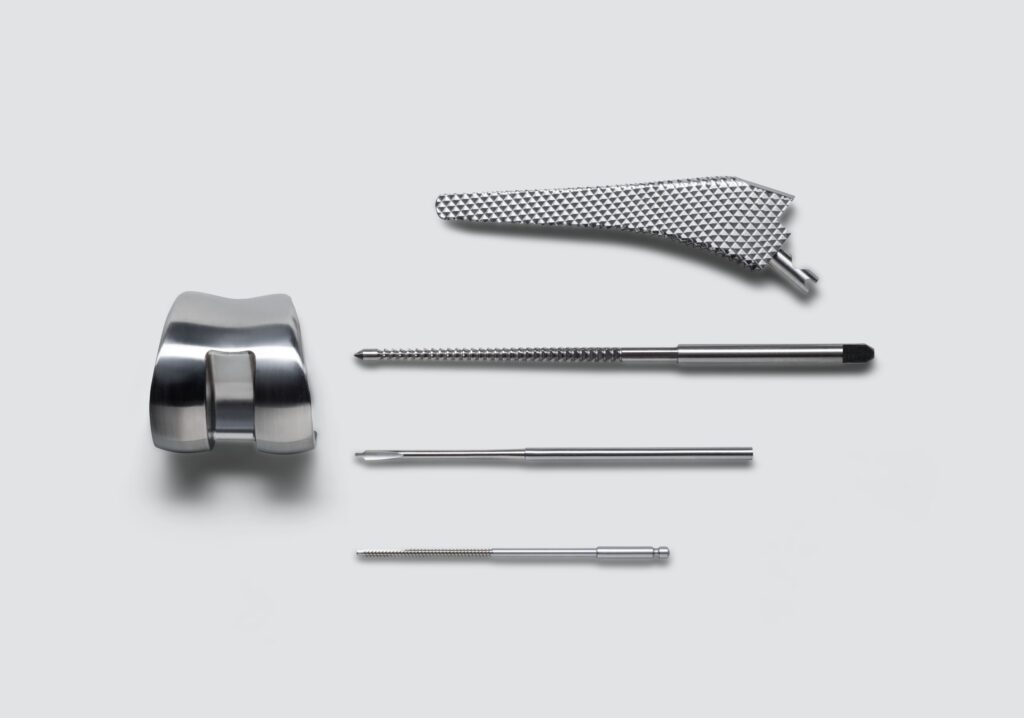
In medical components, grinding is not simply a finishing step. It often determines whether a product can meet its functional requirements at all. For implants and endoprosthetic components, extremely smooth surfaces are needed to reduce the risk of bacterial adhesion and to support reliable performance in the body. In artificial hip ball joints, experts refer to a surface finish with a roughness of Ra below 0.005 μm. At the other end of the size scale, micro injection needles with diameters as small as 0.18 mm must be ground burr free to enable pain free injections. Metallic and bioresorbable stents also depend on smooth polished surfaces, in this case to reduce turbulence in blood flow.
These examples show why medical technology places such high demands on grinding processes. Tolerances can fall into the micrometer range, while component shapes are often complex and materials difficult to machine. Christoph Müller, Head of Sales at Dr. Kaiser Diamantwerkzeuge, describes the field as one of highly demanding processes involving complex shapes, high strength materials and tight tolerances. He points to applications ranging from titanium pins and bone drills to optical devices and dental drills. For production teams, the practical consequence is clear. Surface finish, dimensional stability and edge quality are closely linked, and process windows are narrow.
Why integrated systems are gaining importance
As cost pressure rises, manufacturers are looking beyond individual tools or machines and examining the process as a whole. According to Dr. Kaiser, customers are increasingly turning to customized solutions and process optimization in response to the combined demands for quality, process stability and sustainability. The underlying idea is that efficiency gains are less likely to come from isolated components than from better coordination between tooling, machine technology and application support.
This is why integrated system thinking is becoming more important in medical grinding. Beyond supplying grinding and dressing tools, application engineering is taking on a larger role through seminars, digital support, in-house testing facilities and on-site process design. The aim is to adapt the grinding process to the specific task rather than expecting standard setups to cover every requirement. In a sector with a wide variety of products and materials, that matters. Medical manufacturers need processes that can be tuned for demanding surface requirements, but also scaled for changing product mixes and documentation needs. The closer the interaction between development, tooling and production engineering, the greater the chance of reducing setup effort while maintaining stable output.
Automation, software and measurement in one loop
Machine builders see the same trend from the production side. Marie Sophie Maier, CEO of Adelbert Haas, identifies three main challenges in medical technology: greater process reliability, stricter requirements for reproducibility, and a growing number of product variants. In her view, these conditions increasingly call for automated or semi-automated production environments. What matters is not only the grinding machine itself, but the interaction between machinery, software, clamping and measurement technology.
Adelbert Haas also points to the role of closed loop concepts in this development. In such systems, machining and measuring machines are digitally linked. Data is transferred directly from the machining center to the measuring machine, and the resulting measurement report is sent back to the machine so that corrections can be made automatically. For manufacturers, this approach is relevant because it can reduce manual intervention and support more consistent process control. According to the company, work is also continuing on data-driven optimization of grinding processes and on improving process stability through application-oriented research and development. The company estimates that about 2.4 million knee replacements are manufactured annually on its grinding machines. It also states that investment can pay back quickly through shorter setup times, faster programming, combined grinding and milling, and in-process dressing.
Flexible concepts for a more regulated market
Medical components are becoming more functionally integrated, while regulatory requirements are becoming stricter. For grinding operations, that combination increases the need for processes that are transparent, reproducible and fully documentable. Maier sees a clear trend toward flexible machine and software concepts that can handle new materials, complex geometries and changing requirements more efficiently.
That trend also helps explain why medical technology is receiving attention at GrindingHub, which takes place in Stuttgart from May 5 to 8, 2026, alongside MedtecLIVE from May 5 to 7. The overlap reflects a growing need for exchange across the value chain. As medical device manufacturing becomes more demanding, grinding technology is no longer only about achieving the required surface or geometry. It is increasingly about how reliably that result can be repeated, documented and adapted across a widening range of products.